When a Song Knows Something You Didn't
Why Music Reaches Where Words Can't
There's a specific experience that most people have had but rarely talk about: a song comes on, and something in you opens up in a way that nothing else has been able to manage. Maybe it's a piece of music you've heard hundreds of times, but today it reaches something that's been sealed. Maybe you encounter a new song and it articulates something you've been feeling so precisely that it feels almost supernatural — how did a stranger know this about you?
Music reaches us in ways that verbal language often can't, because it operates on different levels simultaneously. The melody engages pattern-recognition centers in the brain. Rhythm interacts directly with the motor and emotional systems. Harmony creates tension and resolution that mirrors emotional experience. Lyrics, when they land, give language to feeling in ways that feel different from ordinary speech — more compressed, more resonant, more somehow true.
How Music Journaling Uses This
All of this means music is uniquely powerful as an entry point to your own inner life. Songs can access emotional states that you might not be able to approach directly, bypassing the defenses and the self-monitoring that ordinary introspection runs into.
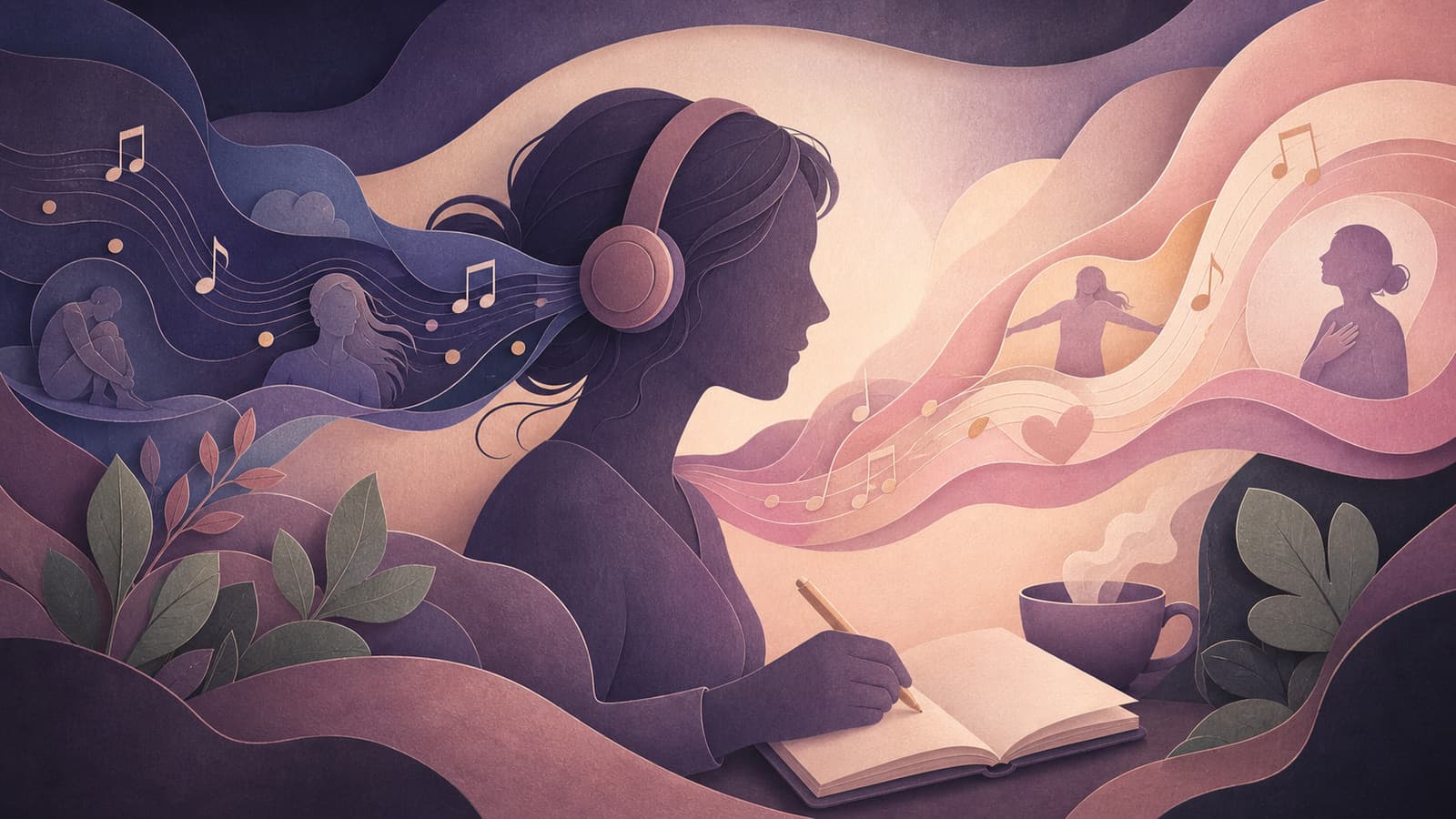
Music journaling harnesses this. It uses music — as a prompt, as a companion while you write, as an object of reflection, as an emotional amplifier — to access and explore interior experience that might otherwise remain unreachable.
This practice pairs naturally with sensory journaling, which uses all the senses as doorways into emotional and experiential awareness. Sound is one of the most powerful sensory channels for emotional access, and music is its most intentionally crafted form.
Opening prompts:
- What is a song that has stayed with you for years? What does it know about you?
- When was the last time a piece of music made you feel something unexpected? What was it, and what did it bring up?
- What musical era of your life do you find hardest to listen to? What is that era about for you?
Let Music Open What Words Can't Reach
Use Muse to combine your musical and journaling practices into a deeper kind of self-expression.
The Science of Why Music Moves You
Memory, Emotion, and the Limbic System
Understanding why music affects you as it does isn't just interesting — it helps you use music journaling more deliberately and with more confidence in what you're doing.
Music activates the limbic system, the part of the brain most closely associated with emotion and memory. This is why music triggers memories with a vividness and immediacy that other cues rarely match — the song from that summer feels like that summer, not just a recollection of it. The emotional state associated with the music is reinstated, not just remembered.
This makes music uniquely useful for accessing emotional material that you might not be able to reach through direct introspection. If you're feeling emotionally flat, or stuck, or unable to identify what you're actually feeling — playing music that resonates with your current life can cut through that numbness and bring you into contact with what's actually there.
Using Music's Physiological Properties Intentionally
Music also affects physiological state in direct and measurable ways. Tempo affects heart rate. Minor keys tend to induce more melancholic states; major keys tend toward uplift. Slow music decreases cortisol. Fast, rhythmic music increases energy and arousal. You can use these properties intentionally — choosing music not just to accompany your writing but to induce a particular emotional state that you want to access and explore.
For those working on developing an emotional vocabulary, music journaling offers a particularly vivid path: songs give you words for experiences you might not have language for yet, and writing in response to them helps you develop that language in your own voice.
Science-inspired prompts:
- What is a song that consistently changes your emotional state? What state does it tend to produce?
- Think of a song strongly associated with a particular memory. What does listening to it feel like in your body?
- Can you use music intentionally to access a feeling you want to write about? Experiment with it right now.
Three Ways to Use Music in Your Journaling Practice
Writing While Listening and Writing in Response
There's no single correct way to do music journaling — the practice is flexible enough to fit very different personalities and writing styles. Here are three distinct approaches, each with its own strengths.
The first is writing-while-listening. Put on music — instrumental works well here, as lyrics can compete with your own thoughts — and write continuously for the duration of a piece. Don't pre-select a topic; simply write whatever the music brings up. Let it be associative, nonlinear, imagistic. The goal is not coherent narrative but access: what does this music open in you?
The second is writing-in-response. Choose a specific song that feels relevant to your current life — one that seems to know something about where you are — and listen to it once or twice before you write. Then write in direct response: what did it bring up? What in the song connected to something in you? This approach produces more reflective, analytical writing and is good for processing specific emotional material.
Using Music as a Prompt
The third is using music as a prompt rather than a companion. Write about music rather than to it: what songs have formed the soundtrack of your life? What does your musical history reveal about who you've been at different chapters? This archival approach is especially useful for memory-keeping and self-understanding across time.
Approach prompts:
- Try writing-while-listening for ten minutes with an instrumental piece. What came up?
- Choose the song that most captures where you are in your life right now. Write in response to it.
- What are the five songs you'd include on the soundtrack of the last year of your life? What does each one represent?
Your Musical Autobiography
From Childhood Through Adolescence
One of the most illuminating exercises in music journaling is creating what you might call a musical autobiography — tracing your life through the songs and music that mattered at each stage.
Start with childhood. What was music in your house like? Was it present and central, or a background thing? What are the earliest songs you remember, and what do you remember about them — not just the music but the context, the feeling, who was there?
Move through adolescence, where music tends to play an especially significant role. For many people, the music discovered between ages thirteen and twenty-three has a particular staying power — these were the years when identity was most actively forming, and the music of that period is woven into the formation in ways that later music rarely is. What were those songs and bands? What did they mean to you then? What do they mean to you now when you encounter them?
The Chapters of Adult Life
Continue through the different chapters of your adult life. The music of a significant relationship. The albums of a difficult period. The songs that marked transition — the end of something, the beginning of something else. The music you discovered alone that felt like finding something you'd been looking for.
This kind of musical autobiography reveals patterns and themes in your life that might be harder to see through ordinary life-narrative writing. Music is rarely incidental — what we choose to listen to, especially during formative or intense periods, tends to reflect who we are more honestly than we might consciously articulate.
Autobiography prompts:
- What was the first piece of music that felt like it was specifically yours — that you chose for yourself rather than inherited from your family?
- Describe the music of your most difficult period. What were you listening to, and what do you think you were looking for in it?
- What song do you associate most with a person you've loved? What happens when you hear it now?
Emotional Translation: Writing What Music Feels
The Challenge of Putting Musical Experience Into Words
One of the more challenging and rewarding music journaling exercises is attempting to translate musical experience into language — to put into words what a particular piece of music does to you, not just what it makes you think about.
This is genuinely hard, and that difficulty is part of the value. Language and music are different kinds of meaning-making, and translating between them requires a particular kind of attention and precision. The experience of reaching for the right words for a musical experience develops exactly the kind of emotional vocabulary that makes all journaling more honest and precise.
Writing the Texture, Not the Category
Try this: listen to a piece of music that moves you. While listening, simply notice — without yet writing — what happens in your body, your emotions, your attention. Where does it pull you? What images or memories or associations does it create? What does it feel like in your chest, or your throat, or your stomach?
Then write it. Not "this song is sad" — that's a category, not an experience. Write the specific texture of what it feels like to be inside this music right now. The particular quality of the longing, or the joy, or the spaciousness. The color and weight and temperature of it. This kind of writing, which borrows from sensory journaling techniques, produces some of the most vivid and honest prose people ever write in their journals.
Translation prompts:
- Listen to a piece of music that moves you. Write what it feels like to be inside that music, using physical and sensory description.
- What emotion does music access in you that you have the hardest time reaching any other way?
- Write a description of silence immediately after a powerful piece of music ends. What is that silence like?
Playlists as Self-Portraits
Private Playlists as Emotional Documents
There's something deeply revealing about the playlists we make. Not the public ones curated for parties or car rides or other people's ears, but the private ones — the ones made at 2am when you're feeling something you can't name, or during a period of your life that is asking more of you than you know how to give.
Spending time writing about a playlist — not just listing the songs but actually examining why you chose them and what they do together — is a form of self-portrait journaling. The playlist is already a document of your inner life; your writing about it makes that document legible.
Reading and Creating Playlists With Intention
Try this exercise: choose a playlist you've made that feels significant, or create one right now that captures where you are. Then write about each song, briefly: why it's in this collection, what it represents, what it says about the overall state or story the playlist is telling. Then read the full playlist description back to yourself. What portrait emerges?
You might also try the reverse: write about a current experience or emotional state, then curate a playlist for it — choosing songs that capture different facets of what you've written about. The act of selecting the right music for a mood requires a specificity of self-understanding that is itself a form of journaling.
Playlist prompts:
- Describe a playlist you've made that feels like it says something true about who you've been in a particular period.
- Make a playlist right now for exactly the emotional state you're in. What songs do you choose? Why those?
- If your life were a film and you had to choose its score, what would it sound like? What pieces would you include?
When Music Opens the Door to Grief
Why Music Reaches What Words Can't
Music has a particular relationship to grief that goes beyond its relationship to other emotions. For many people, music is the only thing that reliably opens the sealed door — the one that keeps grief at a manageable distance until the song comes on and suddenly it's not manageable at all, and you're crying in your car in a parking lot not entirely sure why.
This isn't a problem to be solved. It's the music doing exactly what it's supposed to do: reaching something that your ordinary, managed self has been keeping carefully contained.
Writing From Inside the Feeling
If music consistently opens a grief in you that you haven't been able to approach directly, music journaling can provide a structured way to work with what the music is accessing. Play the song that undoes you. Let it undo you. Then write — not trying to explain or analyze or make sense of it yet, just writing from inside the feeling while it's active.
You might be writing about an obvious loss — someone who died, a relationship that ended, a version of yourself that's gone. Or you might find yourself writing about something more unexpected — a longing for something you never had, a grief for possibility itself, the particular sadness of recognizing how much has passed.
Writing from inside grief, while music holds the door open, is one of the most healing uses of music journaling. It doesn't make the grief go away — nothing does that on command. But it gives the grief somewhere to land, which is different from carrying it indefinitely in a sealed container.
Grief-access prompts:
- What song most consistently opens grief in you? Have you ever written while or after listening to it?
- Write about what the music is actually reaching in you — what it knows about what you're carrying.
- Is there something you're grieving that you haven't given language to yet? Use music to open the door.
Building a Long-Term Music Journaling Practice
Integrating Music Into Your Existing Practice
The most sustainable form of music journaling is probably not a separate, formal practice but a dimension of your existing journaling. You might keep a running log of songs that matter, adding notes about what each one opens in you. You might make it a habit to note, in regular journal entries, what you've been listening to and why. You might occasionally do a deeper music journaling session — a dedicated hour with a playlist and your journal — when you sense there's something you need to access that ordinary writing isn't reaching.
The goal, over time, is to develop a more conscious relationship with what music you're drawn to and what it reveals about your interior life. Music is always telling you something about yourself — the question is whether you're paying close enough attention to hear what it's saying.
Music and Journaling Together
This is ultimately what all journaling is about, whether the entry point is music or memory or mood or anything else. The journal is a tool for paying attention to your own life. Music is one of the most powerful attention-directors available to you. Combining them creates something that is, for many people, more than the sum of its parts: a practice that reaches the parts of you that words alone can't quite find, and then gives those parts words.
Start wherever you are. Play a song that matters. Write what it opens. See what happens. That's enough to begin.
Closing prompts:
- What song would be the most honest soundtrack for who you are right now?
- Write about what you want music to do for you in your journaling practice going forward.
- If music is always telling you something about yourself, what has it been trying to tell you lately?