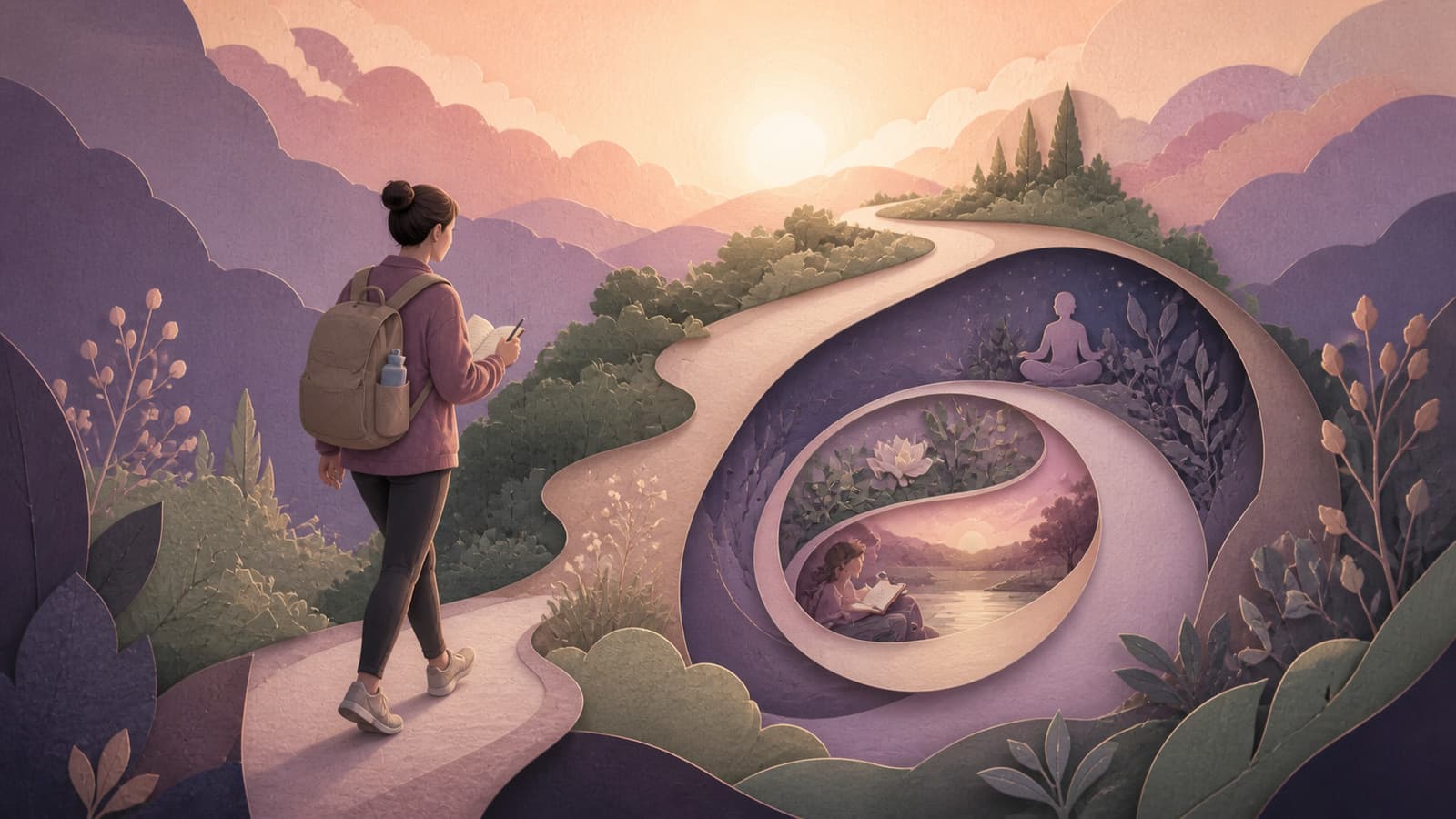
What Happens When You Walk and Notice at the Same Time
There's a particular quality of attention that emerges when you're in motion outdoors. Your body is occupied, your phone is (ideally) in your pocket, and your mind — freed from the tyranny of sitting and staring at a task — starts to wander in a more generative way. You notice things. The way the light falls on a building. A dog being walked by someone who's clearly delighted by it. The smell of rain on pavement. A stranger who holds a door.
These small observations are the raw material of gratitude. And when you pair them with intentional reflection — through a walking journal practice — something interesting happens. The ordinary becomes noteworthy, and the noteworthy accumulates into a kind of daily evidence that your life contains more good than your anxious, distracted mind usually registers.
The gratitude walk is simple in concept: you walk with the intention of noticing what's good, and you record what you find. But the practice runs deeper than it sounds, and the research behind it is substantial. Gratitude journaling science shows that consistent gratitude practices measurably improve mood, sleep quality, and even physical health markers. The walking component adds its own layer of benefit — cardiovascular exercise, exposure to daylight and fresh air, and the specific cognitive benefits of rhythmic movement.
This guide will show you how to combine both into a practice that's genuinely sustainable, not just another wellness commitment that sounds good for three days and then gets forgotten.
Before your next walk: Write down three things you expect to notice on your route. Then go see how many of them you actually observe — and what you notice that you didn't expect.
Bring Your Gratitude Practice Outside
Muse Journal is built for on-the-go reflection — capture your gratitude walk insights wherever you are.
Why Walking Makes Gratitude Feel Different
If you've ever tried to sit at a desk and force yourself to feel grateful, you know it can feel hollow. You write the words, you go through the motions, but the feeling doesn't quite arrive. Movement changes this.
The Neuroscience of Walking and Openness
Walking at a moderate pace activates the same areas of the brain associated with creativity, openness, and perspective-taking. Stanford researchers found that walking — both outdoors and on a treadmill — significantly boosted creative output compared to sitting. But the outdoor version has additional effects: natural environments lower cortisol levels, reduce rumination, and activate what psychologists call "soft fascination" — the effortless, restorative form of attention that you can't force at a desk.
When you walk outside, your nervous system literally shifts toward a calmer state. And in a calmer state, gratitude becomes easier to access. You're not fighting as hard against the noise. You have more bandwidth to notice the texture of the world around you.
The Role of Rhythm and Movement
There's also something to the rhythm. The repetitive motion of walking has a mildly meditative quality. It occupies enough of your attention to quiet anxious thoughts without consuming all of it. The headspace that opens up is where gratitude lives.
Prompt: After your next walk, write about how your mood or mindset shifted from before to after. Did the movement change what you were able to notice or feel? Be specific.
Setting Up Your Gratitude Walk Practice
The best gratitude walk practice is one you'll actually do. Here's how to set it up in a way that fits real life.
Choosing Your Route and Recording Method
Choose your route with intention. You don't need a forest or a beach (though if you have access to either, use them). A neighborhood walk, a park loop, a route through a part of town you don't usually visit — any of these works. The key is that the route feels like a departure from your desk. Different stimuli help.
Decide on your recording method. Some people prefer to walk first and journal afterward, while memories and impressions are fresh. Others use voice memos while walking, speaking observations out loud, then transcribing or reviewing them later. Some keep a small notebook in a jacket pocket for quick notes. Others use a journaling app on their phone. Try a few approaches and see which feels most natural — there's no wrong answer as long as you're actually capturing something.
Setting an Intention and Frequency
Set a loose intention before you leave. Not a rigid goal, but a gentle direction. Some examples:
- "Today I'm going to notice things I usually walk past without seeing."
- "I want to pay attention to the people I encounter."
- "I'm going to focus on physical sensations — temperature, ground underfoot, sound."
- "I'll look for beauty in unexpected places."
This intention shapes what you notice without turning the walk into a performance.
Choose a realistic frequency. A twenty-minute gratitude walk twice a week will serve you better than an ambitious daily practice that collapses after ten days. Start where you can realistically start.
What to Notice: Your In-Walk Gratitude Prompts
Walking opens the aperture of your attention, but it helps to know what to look for. Here are prompts you can hold in your mind as you move — pick one per walk rather than trying to use all of them at once.
Five Walk Types to Explore
The sensory walk. What can you feel, hear, smell, and see that you normally wouldn't attend to? What's the temperature of the air on your skin? What sounds layer on top of each other? What textures are around you?
The people walk. Look at the people you pass. What small acts of care, connection, or simple humanity do you observe? A parent explaining something to a child. Two elderly people talking on a bench. Someone stopping to take a photo of something ordinary.
The beauty walk. Actively hunt for aesthetic pleasure. Colors, light, shapes, unexpected details. The worn pattern on a brick wall. The way shadows fall at this particular hour. The architectural detail you've walked past a hundred times without seeing.
The abundance walk. Notice all the things around you that represent care, effort, or provision — the paved road, the maintained park, the shop someone opened and tends every day. This one is particularly good for shifting perspective on difficult days.
The personal inventory walk. Bring a current challenge with you and notice what observations spark thought about it. Let the walking and the environment become a thinking partner.
For those drawn to the nature dimension of this practice, nature journaling offers a complementary approach — spending time in natural settings with close observational attention as the primary goal.
Prompt: Choose one of the five walk types above for your next walk. When you return, write for ten minutes about what you noticed and how it connected to gratitude.
The Post-Walk Journal Entry: How to Capture What You Found
The walk is where you gather. The journal is where you make sense of it. Your post-walk entry doesn't need to be long — sometimes five to ten minutes is exactly right — but it should be specific.
The Five Elements of a Strong Post-Walk Entry
The three observations. Write down three specific things you noticed during the walk that you're grateful for. Not categories ("I'm grateful for nature") but specific instances ("I'm grateful for the dogwood tree two blocks from my building that was just starting to drop its petals, and the fact that I happened to walk by today").
The shift. Write about how you feel now compared to before you left. Did anything change? Sometimes the shift is dramatic and sometimes it's subtle — both are worth noting.
The unexpected. What surprised you? What did you notice that you weren't looking for? These unexpected observations are often the most valuable, because they point to a quality of attention that's genuinely open rather than just going through the motions.
The carry-forward. Is there anything from the walk — an image, an observation, a feeling — that you want to hold onto through the rest of the day? Write it down explicitly. This is your anchor.
The connection. How does what you noticed connect to your larger life? Sometimes the answer is nothing, and that's fine. But sometimes a small observation on a walk illuminates something much bigger about what you value or what you want.
Your walking journal can become one of the most intimate records you keep — a log of how the world looked and felt at specific moments in your life. Months and years later, it becomes something surprisingly moving to read.
Building the Habit: Making Gratitude Walks Stick
The biggest obstacle to any wellness practice is continuity. The initial enthusiasm fades, life gets complicated, and gradually the practice slips. Here's how to build gratitude walks in a way that actually persists.
Reducing Friction
Attach them to something existing. If you already have a lunch break, a commute, a dog to walk, a time you drop someone off — use that. The walk that requires a separate block of time in an already full schedule is the walk that doesn't happen. The walk that replaces a purposeless phone scroll during an existing break is the walk that does.
Lower the entry barrier. Your shoes are already on. Your jacket is already by the door. Your journal is on your phone. The less friction between you and the walk, the more likely you are to do it.
Keeping the Practice Alive
Accept imperfect conditions. Light rain is fine. Moderate cold is fine. Tired is fine. The gratitude walk that happens in suboptimal conditions is often better than a walk in perfect conditions, because noticing goodness despite difficulty is a more meaningful practice. (Heavy rain and extreme weather are, naturally, exceptions.)
Track your streak loosely. Not obsessively — not in a way that makes you anxious about breaking it — but keep a simple note of how many walks you've done in a month. Seeing a number accumulate creates its own gentle motivation.
Vary your routes. The same route walked weekly starts to lose its capacity to generate fresh observations. Rotate through two or three different routes, or deliberately choose an unfamiliar direction once a month.
Seasonal Gratitude Walks: How Each Season Changes the Practice
One of the quiet gifts of a sustained gratitude walk practice is watching the same world change across seasons. A route you know well in October looks completely different in February, and completely different again in April.
Spring walks tend to generate gratitude almost automatically — new growth, warming temperatures, longer light, the sensory richness of bloom and birdsong. The challenge in spring is to look past the obvious and find the specific.
Summer walks offer heat, abundance, long evenings, the particular quality of late-afternoon light. Notice what's lush and full. Notice what you've taken for granted since spring.
Autumn walks are many people's favorite for this practice. The heightened sensory beauty, the poignant transience, the crispness of the air. Autumn is particularly good for reflecting on what has reached completion in your own life, not just in the natural world.
Winter walks require more intentional looking. The landscape is stripped down, which makes what remains more visible. Bare trees show their structure. Frost creates patterns. There's a particular quality of winter light in the low late-afternoon sun that's worth being outside for.
Prompt: Write about the season you're in right now. What's specific to this time of year that you're grateful for? What will you miss when it passes?
The Gratitude Walk as a Relationship Practice
Gratitude walks don't have to be solitary. Walking with another person — a partner, a friend, a child — while holding a gratitude intention transforms the conversation that usually happens on a walk.
Instead of problem-solving or catching up on logistics, try this: both of you commit to pointing out things you notice and appreciate as you walk. No analysis, no agenda — just shared attention and shared appreciation.
The effect is often surprisingly connecting. You learn what the other person notices. You see familiar routes through unfamiliar eyes. And there's something about the side-by-side nature of walking that makes certain kinds of sharing easier than face-to-face conversation.
After the walk, you can each write independently about what you noticed, then share your entries. Or you can write a shared entry together, each contributing observations.
This relational dimension connects to the broader practice of using journaling to deepen connections — the kind of attention that gratitude walks cultivate has a way of carrying over into how you listen and notice in daily life.
Prompt: Think of someone you'd like to take a gratitude walk with. What do you think they'd notice that you'd miss? What might you point out to them? Write about what the walk might reveal.
What Your Gratitude Walk Journal Will Become
Six months of consistent gratitude walk entries creates something remarkable: a sensory archive of your life. Reading back through it, you'll find you've documented the light on a specific winter afternoon, the smell of a neighborhood bakery, the sound of rain on leaves during an October walk when you were going through something hard and the walk helped.
You'll find evidence of resilience — the walks you took when you didn't feel grateful and had to look harder for it. You'll find the evolution of what you value and what you notice. You'll find a record of seasons and years that would otherwise exist only as vague impression.
The gratitude walk journal is, in a sense, a love letter to your own life — written in small installments, one walk at a time.
If you want to extend your gratitude practice beyond the walks, gratitude journaling science explains what the research says about different formats and frequencies, and can help you build a comprehensive practice that works on the days when you can't get outside too.
Final prompt: Write about a walk from your past — a walk you remember for some reason, even if the reason isn't clear. What do you remember noticing? What were you grateful for then, even if you didn't name it that way at the time?