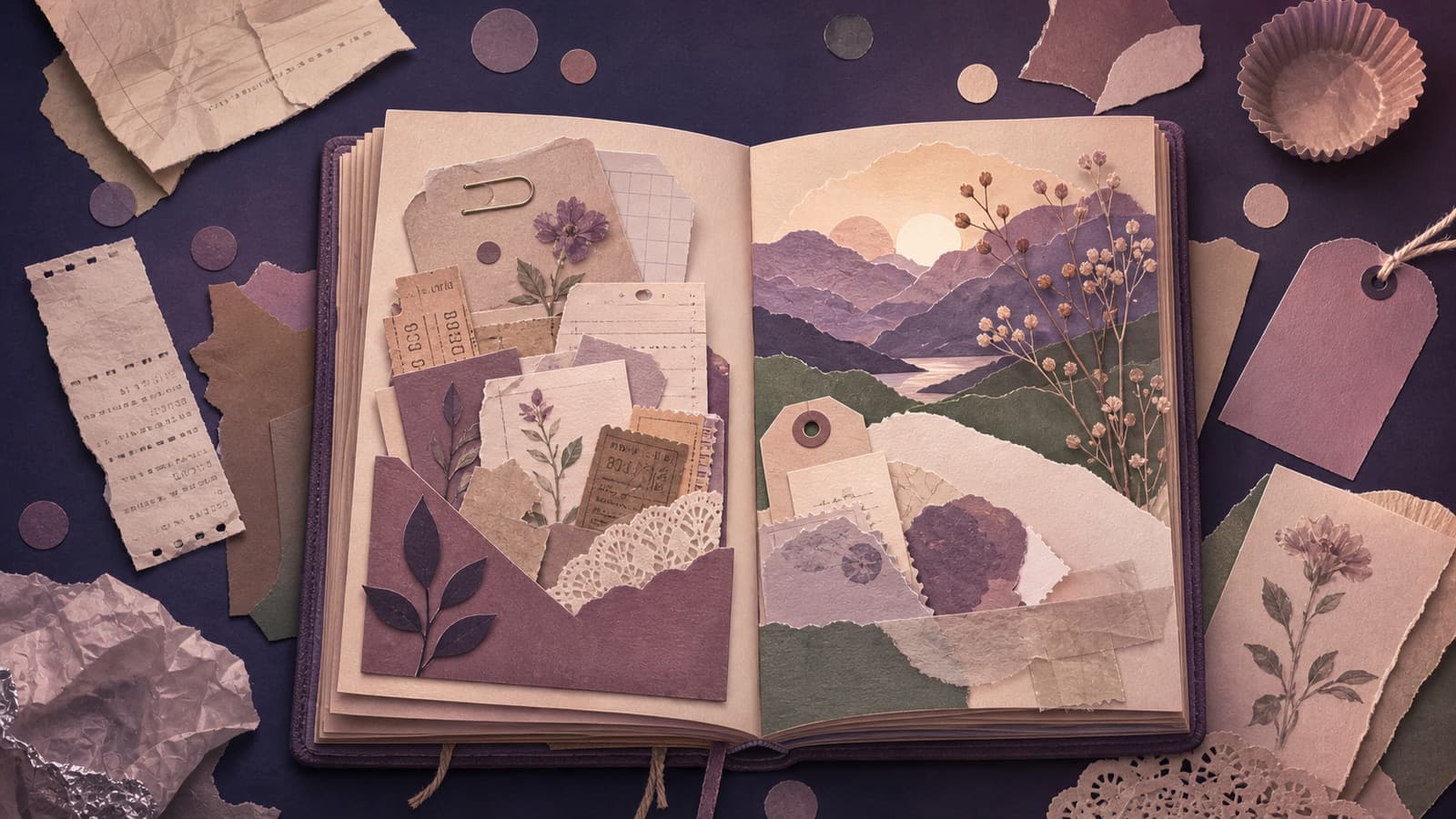
That crumpled movie ticket at the bottom of your bag. The handwritten receipt from the cafe where you had your first date. The tag from the shirt you bought on a trip you still think about. You keep these things because they carry weight -- small, tangible proof that a moment actually happened.
Junk journaling is the practice of giving these scraps a home and a story. It transforms the bits and pieces of daily life into pages that are part scrapbook, part diary, part art project. And unlike traditional journaling, it does not ask you to start with a blank page. It asks you to start with what you already have.
What Is Junk Journaling?
Junk journaling is a form of creative journaling built around found materials and everyday ephemera. The "junk" in the name is intentional -- it refers to the ordinary, overlooked, often-discarded items that most people throw away without a second thought. Envelopes, packaging, old book pages, postage stamps, fabric scraps, napkins, dried flowers, stickers peeling off fruit. In a junk journal, these materials become the foundation for pages that document your life, explore your thoughts, or simply give you a creative outlet.
The practice sits at the intersection of scrapbooking, art journaling, and written reflection. But it is more relaxed than any of those. There are no expensive supplies to buy, no techniques to master, and no standard of quality to meet. If you can glue something to a page and write next to it, you can junk journal.
What separates junk journaling from a simple scrapbook is the emphasis on process over product. A scrapbook typically aims for a polished, curated result. A junk journal embraces imperfection. Pages can be lumpy, uneven, torn, and layered to the point where they barely close. That is part of the appeal -- the physical thickness and texture of a well-used junk journal tells you that this object has been lived in.
If you are entirely new to journaling as a practice, our guide to journaling for beginners covers the habits and mindset that apply across all journaling styles. Junk journaling adds a tactile, visual dimension to those same principles.
Pair Your Physical Journal with Digital Memories
Muse Journal lets you photograph your junk journal pages and pair them with written reflections. Free on iOS.
Materials Worth Collecting
The best part of junk journaling is that your supplies are free and everywhere. Once you start looking, you will notice potential journal materials in places you previously ignored. Here is what to keep an eye out for.
Paper Ephemera
- Receipts and invoices. Especially from meals, shops, or experiences that mattered to you. A grocery receipt from a dinner party tells a story.
- Tickets and boarding passes. Concert stubs, museum admissions, transit tickets, airline boarding passes. These are timestamps with built-in context.
- Postcards and greeting cards. Whether received or collected from racks in hotel lobbies.
- Envelopes and postage. The handwriting on an envelope from someone you love is irreplaceable.
- Maps and brochures. Tourist maps, event programs, instruction leaflets.
- Packaging. Tea bag wrappers, candy bar labels, interesting food packaging, seed packets.
- Old book pages, sheet music, and newspaper clippings. Secondhand bookshops and library sales are treasure troves.
Non-Paper Materials
- Fabric scraps. A strip of ribbon, a piece of lace, a swatch from a shirt you are retiring.
- Pressed flowers and leaves. Flat, dried botanical elements add organic texture.
- String, twine, and thread. Useful for binding, decoration, and tactile contrast.
- Stickers and labels. Address labels, brand stickers, decorative stickers from packaging.
Found and Printed Materials
- Photographs. Printed snapshots, photo booth strips, or prints from your phone.
- Handwritten notes. Grocery lists, to-do lists, messages written on scraps of paper.
- Digital prints. Quotes, patterns, or images you print at home on regular paper.
The key principle is intentional collecting. You do not need to hoard everything. You need to notice the items that spark a small feeling -- nostalgia, curiosity, warmth, humor -- and set them aside instead of tossing them in the recycling bin. A small envelope or box by your door works well as a collection point.
Building a Junk Journal from Scratch
You do not need to buy a premade journal. In fact, making the journal itself is part of the practice. Here is a straightforward approach that requires no bookbinding experience.
The Simple Signature Method
- Gather your pages. Collect 8-12 sheets of mixed paper -- old envelopes (opened flat), brown paper bags, pages from discarded books, cardstock, patterned scrapbook paper, or plain printer paper. Variety is the point.
- Fold and nest. Fold each sheet in half. Stack them inside each other in groups of 3-4 folded sheets. Each group is called a signature.
- Create a cover. Use a piece of heavier material -- cardboard from a cereal box, a section of a paper bag, a piece of chipboard -- folded to the same size as your signatures.
- Punch and bind. Use a needle or awl to punch 3-5 holes along the spine of each signature. Sew through the holes with embroidery thread, twine, or even dental floss. Tutorials for pamphlet stitch binding are widely available and take minutes to learn.
- Embellish the cover. Layer paper, fabric, or decorative elements on the front. Or leave it raw. Both approaches work.
The result is a handmade journal with pages of different colors, textures, and weights. This unevenness is not a flaw -- it is the visual character that makes junk journals distinctive.
Using an Existing Base
If building from scratch feels like too much, start with a composition notebook, an old hardcover book, or a cheap journal from a dollar store. You can glue over existing pages, add fold-out flaps by taping in extra paper, and create pockets by gluing envelopes to pages. The structure exists already; your job is to transform it.
Incorporating Ephemera Meaningfully
The difference between a pile of old receipts and a junk journal is context. The materials become meaningful when you pair them with reflection -- even a few words of annotation transforms a random scrap into a memory artifact.
Here are approaches for making your ephemera purposeful.
Annotate Everything
Write the date, the location, who you were with, or what you were feeling. A coffee shop receipt taped to a page is mildly interesting. The same receipt with "Tuesday after the phone call with Mom -- sat here for two hours and watched the rain" written beside it is a memory you will be grateful to have in ten years.
Layer for Depth
Place items on top of each other. A map under a photograph under a handwritten note creates visual depth that mirrors the layered nature of experience. You were not just at a place -- you were navigating, seeing, and thinking, all at once.
Create Pockets and Fold-Outs
Not everything needs to be permanently glued down. Use envelopes, folded paper, or small bags attached to pages to create pockets that hold loose items -- a pressed flower, a small note, a polaroid. The act of reaching into a pocket and pulling something out adds an interactive, intimate quality to the journal.
Combine Writing with Mixed Media
Some of the most powerful junk journal pages pair long-form writing with visual elements. Write a full journal entry on a page, then layer ephemera around the text. Or do the reverse -- build a collage page first, then write your reflection on a separate piece of paper and tuck it inside a pocket on the page. This combination of creative expression and reflective writing gives your journal both emotional depth and visual richness.
Themes and Organization
Junk journals can be organized in many ways, or not organized at all. Both approaches are valid. Here are common structures that people find useful.
Chronological
Simply work through the journal in order, documenting your life as it happens. This is the easiest approach and produces a journal that reads like a visual diary. Each page or spread corresponds to a day, a week, or an experience.
Thematic
Dedicate an entire journal to a single theme. Common themes include:
- Travel. One journal per trip, filled with maps, tickets, photos, menus, and travel reflections. If you already keep a travel journal, a junk journal version adds a physical, tactile dimension to those memories.
- Seasons. A journal for each season, documenting the colors, events, and rhythms of that time of year.
- Milestones. A journal documenting a pregnancy, a child's first year, a year of recovery, a big move.
- Gratitude. Each page features one thing you are thankful for, illustrated with related ephemera.
Freestyle
No plan, no structure, no rules. Open to any page and put whatever you want on it. This approach works well for people who resist structure or who want their journal to feel like a playground rather than a project.
Junk Journaling for Travel Memories
Travel is one of the most natural contexts for junk journaling, because travel generates ephemera without any effort. You accumulate maps, transit tickets, museum brochures, restaurant cards, hotel stationery, foreign currency, and packaging with text in other languages. Instead of shoving these into a drawer when you get home, carry a small envelope during your trip and collect as you go.
A travel junk journal becomes a sensory record of the trip that photographs alone cannot capture. The texture of a handmade paper from a street market. The smell of a dried lavender sprig from a garden you visited. The ink from a pen you bought at a bookshop in a city you fell in love with. These physical objects trigger memories that are more vivid and specific than any digital photo, and they complement a photo journaling practice by adding materiality to visual memories.
Build your travel junk journal during the trip if possible. Sit in a cafe at the end of each day, tape in what you collected, and write a few lines about where you went and how you felt. The act of processing the day through your journal becomes part of the travel experience itself.
The Sustainability Angle
Junk journaling is, by nature, a practice of reuse. Every candy wrapper you glue into your journal is a candy wrapper that does not go to a landfill. Every old book page you repurpose extends its life. Every paper bag you turn into a journal cover is one less thing discarded.
This is not to say that junk journaling will solve the waste crisis. But it does cultivate a different relationship with materials. You begin to see potential in things that were previously invisible. Packaging becomes texture. Junk mail becomes collage material. Old calendars become journal pages. This shift in perception -- from disposable to usable -- often extends beyond the journal and into how you think about consumption and waste more broadly.
If sustainability matters to you, junk journaling aligns your creative practice with your values in a concrete, daily way.
Junk Journaling as Meditation
The tactile, repetitive nature of junk journaling -- sorting, cutting, tearing, arranging, gluing, writing -- creates a meditative state that is difficult to achieve through writing alone. Your hands are busy. Your attention is focused on texture, color, and spatial arrangement. Your analytical mind quiets because the task does not demand analysis. It demands presence.
This is similar to what people experience in activities like knitting, gardening, or cooking -- a flow state where the body is engaged and the mind is free to wander, process, and rest. For people who find traditional seated meditation difficult, junk journaling offers an alternative path to the same kind of mental stillness.
The imperfection inherent in the practice also reinforces a meditative principle: letting go of control. Pages will not turn out the way you planned. Glue will wrinkle. Colors will clash. Items will be placed off-center. And none of it matters. The practice teaches you to work with what you have, accept what happens, and find beauty in the unplanned. These are lessons that transfer well beyond the journal.
Keeping a Memory Archive
One of the most valuable functions of a junk journal is its role as a memory-keeping practice. Digital photos capture what things looked like. Written journals capture what you thought. Junk journals capture what things felt like -- through the physical objects that were present in a moment.
Years from now, you will open your junk journal and find the wrapper from the chocolate bar you ate on a park bench the day you got good news. You will find the napkin from the restaurant where your friend told you something important. You will find the tag from the plant you bought when you moved into your first apartment. These objects are time capsules. They do not just remind you that something happened -- they put you back in the room, on the bench, at the table.
This is why annotation matters so much. The object triggers the memory, but the written context ensures the memory stays clear even as years pass and details fade.
Getting Started with Minimal Supplies
You do not need to wait until you have the perfect setup. Here is how to make your first junk journal page in the next ten minutes.
What you need:
- Any notebook, or a few sheets of paper stapled together
- A glue stick or tape
- One or two items from your wallet, bag, or desk -- a receipt, a sticky note, a business card, a piece of packaging
- A pen
What to do:
- Open to a blank page.
- Tape or glue your items onto the page. Do not worry about placement -- just put them down.
- Write the date.
- Next to each item, write one sentence about where it came from or what it means to you.
- If you have a colored pen or pencil, add a border, an underline, or a small doodle.
That is your first junk journal page. It took five minutes. It cost nothing. And it preserved a small piece of your life that would otherwise have been forgotten.
The practice grows from here. Start a collection envelope. Notice what you pick up and what you pass by. Pay attention to the scraps and fragments of your daily life, because they are telling a story whether you capture it or not.
Junk journaling simply gives that story a place to live.