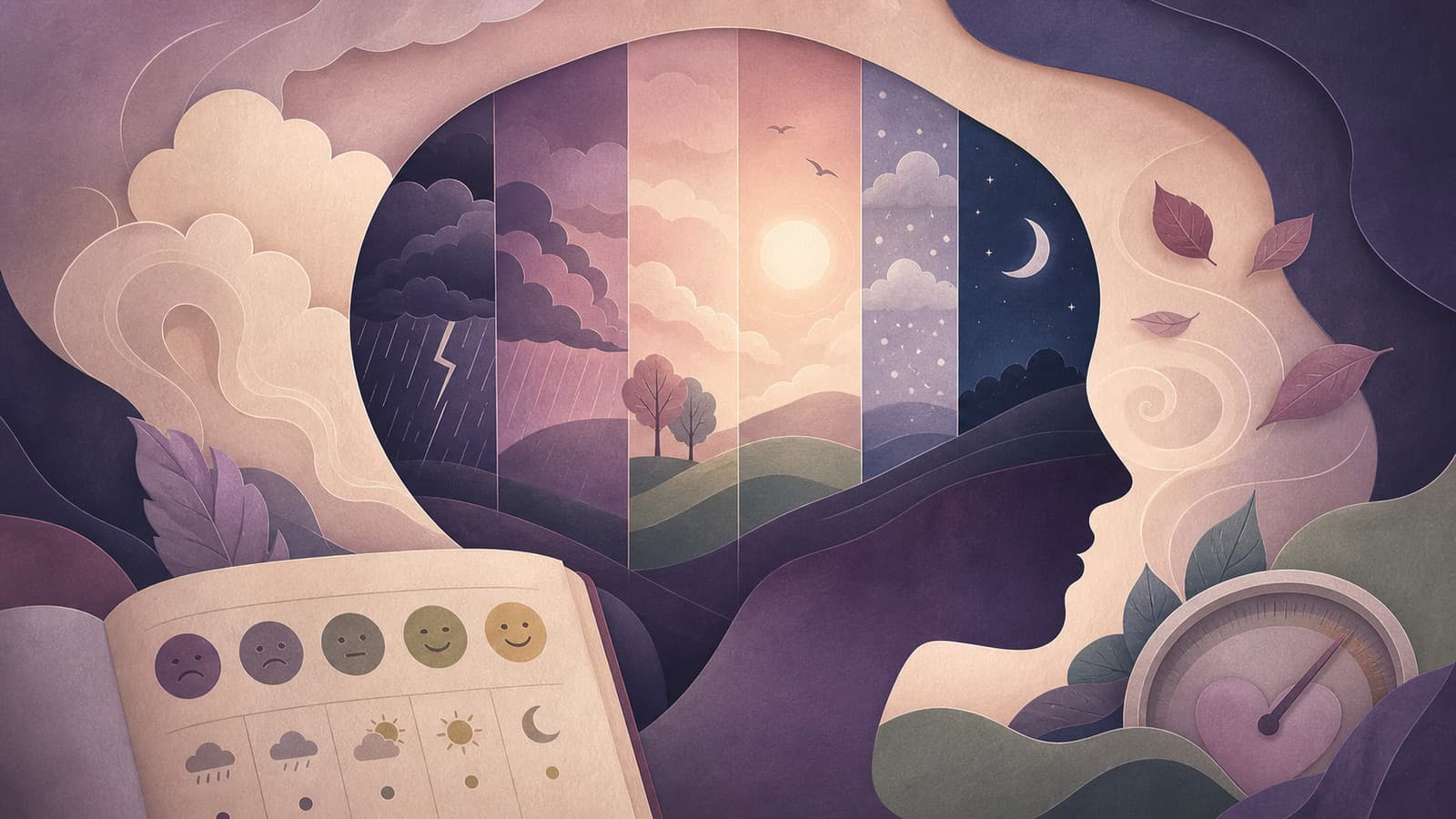
You Are Not Imagining It — The Weather Is Affecting You
There's something deeply validating about noticing, on your third gray day in a row, that you feel inexplicably flat. Not sad about anything in particular. Not anxious. Just dim. And then, when a rare patch of winter sun finally breaks through, the lift in your chest feels almost physical. Like someone turned up the brightness on everything.
You are not being dramatic. You are responding to real environmental inputs in ways that are completely normal and extensively documented. Light levels regulate serotonin and melatonin production. Barometric pressure shifts correlate with migraine frequency and joint discomfort. Heat affects cognitive performance and emotional reactivity. Cold and darkness alter sleep architecture. Your body and brain are not sealed systems — they're in constant conversation with the atmospheric world around them.
What most people never do is actually track this relationship. They feel the effects without connecting them to their cause, which means they can't prepare, adapt, or even simply reassure themselves that the mood they're carrying has an environmental explanation and will shift when the weather does.
Weather and mood journaling changes this. By systematically recording both external conditions and internal states, you build a personal dataset that reveals patterns unique to your physiology and psychology. Combined with consistent mood tracking, this kind of journaling becomes a practical tool for understanding one of the most overlooked drivers of daily emotional life.
Opening prompts:
- How does today's weather feel to you physically? Where do you notice it in your body?
- What kind of weather makes you feel most alive? Most drained?
- Look back at the last week. Does your mood seem to correlate with anything happening in the sky?
Track Your Mood and Weather in One Place
Use Muse to build a personal record of how the environment shapes how you feel.
What the Research Actually Says
Light, Temperature, and Your Emotional State
The relationship between weather and mood is real, though it's more nuanced than "sunny equals happy." Research on what's been called seasonal journaling for depression and mood variation shows several consistent patterns worth understanding.
Light is the most significant factor. Exposure to bright light — particularly sunlight in the morning — directly stimulates serotonin production and helps regulate the circadian rhythm. When light drops in winter months, some people experience a dramatic shift in mood, energy, appetite, and sleep. This is Seasonal Affective Disorder, which affects millions of people and exists on a spectrum from mild "winter blues" to clinical depression.
Temperature affects both mood and cognition. Studies have found that moderate warmth tends to improve mood and increase prosocial behavior. Extreme heat, however, does the opposite — it increases irritability and can impair decision-making. You may have noticed yourself being shorter-tempered during heat waves. That's not just perception.
Humidity, Pressure, and Wind
Humidity influences perceived discomfort and can affect energy levels significantly. Many people find high humidity profoundly draining without being able to articulate why — the air just feels like it's working against them.
Barometric pressure changes — the atmospheric shifts that precede storms — correlate with headaches, joint pain, and mood dips for a meaningful portion of the population. If you've ever found yourself inexplicably out of sorts on a day before a storm rolls in, you may be more barometrically sensitive than average.
Wind has its own psychology. In many cultures, certain winds have historically been associated with irritability and unease — the Mistral in southern France, the Chinook in North America, the Sirocco in the Mediterranean. These aren't superstitions; they're observations of real patterns.
Research-inspired prompts:
- Do you notice your sleep changing across seasons? How does that affect how you feel?
- Track your energy levels at the same time each day for a week alongside the weather conditions. What do you notice?
- When was the last time you had a headache or felt physically off? What was the weather doing?
How to Set Up Your Weather Mood Journal
The Minimal Daily Entry
The beauty of a weather mood journal is that it can be as simple or as structured as you want. What matters is consistency — recording enough data points over enough time to actually see patterns emerge.
A minimal daily entry might look like this: date, weather conditions (sky, temperature, precipitation), your mood on a simple scale of one to ten, your energy level, and two or three sentences about how you feel. That's five minutes at most, and over a month you'll have thirty data points to look at.
A more detailed approach might include: sunrise and sunset times and whether you got outdoor light exposure, humidity and barometric pressure (both easily found on weather apps), sleep quality from the night before, physical sensations, and a fuller narrative entry about your emotional state.
Timing and Visualization
The key is to record the weather and the mood at the same time — ideally in the morning and again in the evening — rather than trying to reconstruct them from memory later. Memory is a poor meteorologist when it comes to subtle moods.
Many people find it useful to color-code their entries over time. Assign colors to mood ranges and weather conditions and you'll start to see visual clusters in your journal — streaks of gray mood that align with cloudy weeks, bright patches that match the sunny days.
Setup prompts:
- Design your ideal weather mood tracking system. What would you include? What would you leave out?
- What time of day do you think your mood is most reliably representative of how you're actually feeling?
- What weather data would be most meaningful to track given your personal experience of climate?
Discovering Your Personal Weather Patterns
What Makes Your Patterns Unique
Everyone's weather-mood relationship is unique. Some people genuinely thrive in winter — they love the quiet, the cozy indoors, the crispness of cold air. Others are dramatically affected by the loss of light. Some feel their best on overcast days, which feel calm and conducive to thinking. Others find cloudless skies reliably energizing.
The goal of weather mood journaling isn't to confirm what the research says — it's to discover what's true for you specifically. And sometimes personal experience diverges from the averages in interesting ways.
Reading Your Data and the Exceptions
After a month or two of consistent journaling, set aside time to review your entries and look for patterns. Ask yourself: Are there specific conditions that consistently lift my mood? Are there conditions that reliably drain me? How long does a weather effect tend to last — does a rainy mood clear up by afternoon, or does it persist into the next day? Do weather effects seem stronger during certain seasons or life circumstances?
Look also at the exceptions — the sunny days when you still felt flat, the rainy days when you were inexplicably energetic. What else was going on those days? Sleep, social connection, physical activity, and workload all interact with weather to produce your actual daily mood. Seeing this complexity is itself useful: it prevents you from over-attributing mood to weather and helps you understand the full picture.
Pattern-discovery prompts:
- Review the past two weeks of your journal. What conditions seem to have accompanied your best days? Your hardest?
- Write about a time when the weather exactly matched your mood. Did the weather cause the mood, or did it just amplify something already present?
- What conditions make it easiest for you to focus and do creative work?
Nature Journaling as a Companion Practice
The Practice of Noticing
Weather journaling and nature journaling are natural companions. Where weather journaling is primarily about tracking effects on you, nature journaling invites you to pay close attention to the living world around you — and that attention itself has significant emotional benefits.
Nature journaling in the traditional sense involves observing and recording what you see: the light on a particular morning, the behavior of birds before a storm, the way frost patterns form on glass, the sound of rain hitting different surfaces. It's a practice of noticing, and noticing is inherently grounding. It pulls you out of rumination and into the sensory present.
Connecting Inner and Outer Worlds
When you combine nature journaling with mood tracking, you add a layer of meaning to both practices. You're not just recording that you saw geese flying south — you're recording what it felt like to see them, what it made you think about, how the crisp autumn air felt on your face in that moment. You're connecting your inner world to the outer one, which is itself a form of healing for the disconnection many of us carry.
There's also something specifically helpful about noticing that the natural world has seasons and cycles that are far larger than your current mood or circumstances. The winter that feels endless always ends. The barren landscape always, eventually, greens again. Tracking the seasons in your journal makes this visible in a way that's quietly sustaining.
Nature journaling prompts:
- Describe the weather outside right now in as much sensory detail as you can — light, sound, smell, temperature.
- What changes have you noticed in the natural world over the past month? Plants, animals, light?
- Write about a moment in nature that shifted your mood. What was it about that moment?
When Your Mood and the Weather Tell Different Stories
Good Mood on Bad Weather Days
One of the more interesting discoveries in weather mood journaling is when you find consistent disconnects — days when you feel bright despite terrible weather, or inexplicably heavy on beautiful days. These moments are worth investigating.
Good mood on a bad weather day might mean: you got enough sleep, you had meaningful social contact, you're engaged in work that matters to you, or you're in a period of life that's generally going well. It can also mean you have a genuinely positive relationship with certain "bad" weather — many people find storms thrilling rather than depressing.
Low Mood on Beautiful Days
Low mood on a good weather day is often more telling. It can point to internal factors that are unrelated to environment: unprocessed grief, relationship tension, work stress, or simply a body that needs rest. Sometimes the contrast between the beauty outside and the flatness inside creates an additional layer of confusion or guilt — you feel like you should feel good, which makes the not-feeling-good worse.
Journaling through these mismatches helps you disentangle weather from mood and develop a more nuanced understanding of what actually drives your emotional state. If you're working through more persistent low mood, exploring journaling for seasonal depression may offer additional frameworks specifically designed for that experience.
Mismatch prompts:
- Write about a time when you felt terrible on a beautiful day. What was actually going on?
- When you feel low during good weather, do you notice yourself feeling guilty or confused about it? What would you say to a friend who described that experience?
- What does it mean to you when the weather "matches" your mood?
Using Your Weather Data to Prepare and Adapt
Planning Around Your Patterns
Once you have a few months of weather mood data, you can start using it proactively. This is where the practice moves from interesting observation to practical life tool.
If you know you tend to feel low during extended cloud cover, you can prepare: schedule your most demanding work before the gray stretch hits, make sure you have social plans during that period, and get outside for whatever light is available as early in the day as possible. You can also be gentler with yourself during that time, knowing it's a weather effect rather than a character flaw.
Scheduling for Your Best Windows
If you know a certain type of weather is reliably energizing for you, you can plan to do difficult or ambitious things during those windows. Some people find their best creative output happens during rain; others are sharpest on cold, clear days. Using your data to schedule accordingly is a small but meaningful form of self-optimization.
For people who experience significant seasonal mood changes, the data from weather mood journaling can also be valuable to share with a therapist or doctor. It creates an evidence base rather than a vague sense that "winter is always hard," and it can support conversations about interventions like light therapy, medication adjustments, or lifestyle changes during vulnerable seasons.
Adaptation prompts:
- Based on what you know about your weather-mood patterns, what could you change about how you structure your weeks in different seasons?
- What coping strategies have you noticed working best when weather is affecting you negatively?
- Write a letter to yourself to read at the start of your most difficult season. What do you most need to remember?
Making Peace With Seasons You Don't Love
Finding Something Real in the Difficult Season
There may be entire seasons of the year that you genuinely struggle with. For many people, late autumn and winter feel like a sustained assault on their sense of self. The darkness is real, the cold is real, and the mood effects are real. But there's also something that journaling can help with beyond simply tracking the problem — and that's building a different relationship with the difficult season.
This doesn't mean pretending to love winter when you don't. It means finding, through deliberate attention, the things about that season that you actually can appreciate. The forced slowing down. The particular quality of low winter light. The permission to be indoors without guilt. The way the world becomes quieter.
From Passive Victim to Active Observer
Weather mood journaling, over time, shifts you from passive victim of the seasons to active observer of them. You become someone who knows their own patterns, who can name what's happening and why, and who has developed genuine strategies for navigating the hard parts. That's not a small thing.
If your mood patterns are significantly affecting your daily functioning, please consider seeking support beyond journaling. Seasonal Affective Disorder is a real condition that responds to treatment, and no amount of journaling replaces professional care when that care is needed. But as an ongoing companion practice — one that builds self-knowledge and connects you more consciously to the world you live in — weather mood journaling is quietly transformative.
Closing season prompts:
- What season of the year are you currently in? How does it feel in your body and mood right now?
- What is one thing you genuinely appreciate about your most difficult season, however small?
- Imagine you're writing to someone who shares your weather sensitivities. What would you want them to know?