You open your journal and stare at the blank page. The cursor blinks, or the pen hovers. Words feel inadequate. You know something is stirring inside you, but language cannot quite capture it.
This is where art journaling comes in. Not as a replacement for written journaling, but as an expansion of it -- a way to express what words alone sometimes cannot reach.
And before you close this page thinking "I can't draw" -- that is exactly why you should keep reading. Art journaling has nothing to do with artistic talent. It is about giving your inner world a visual form, however rough, abstract, or unconventional that form might be.
What Is Art Journaling?
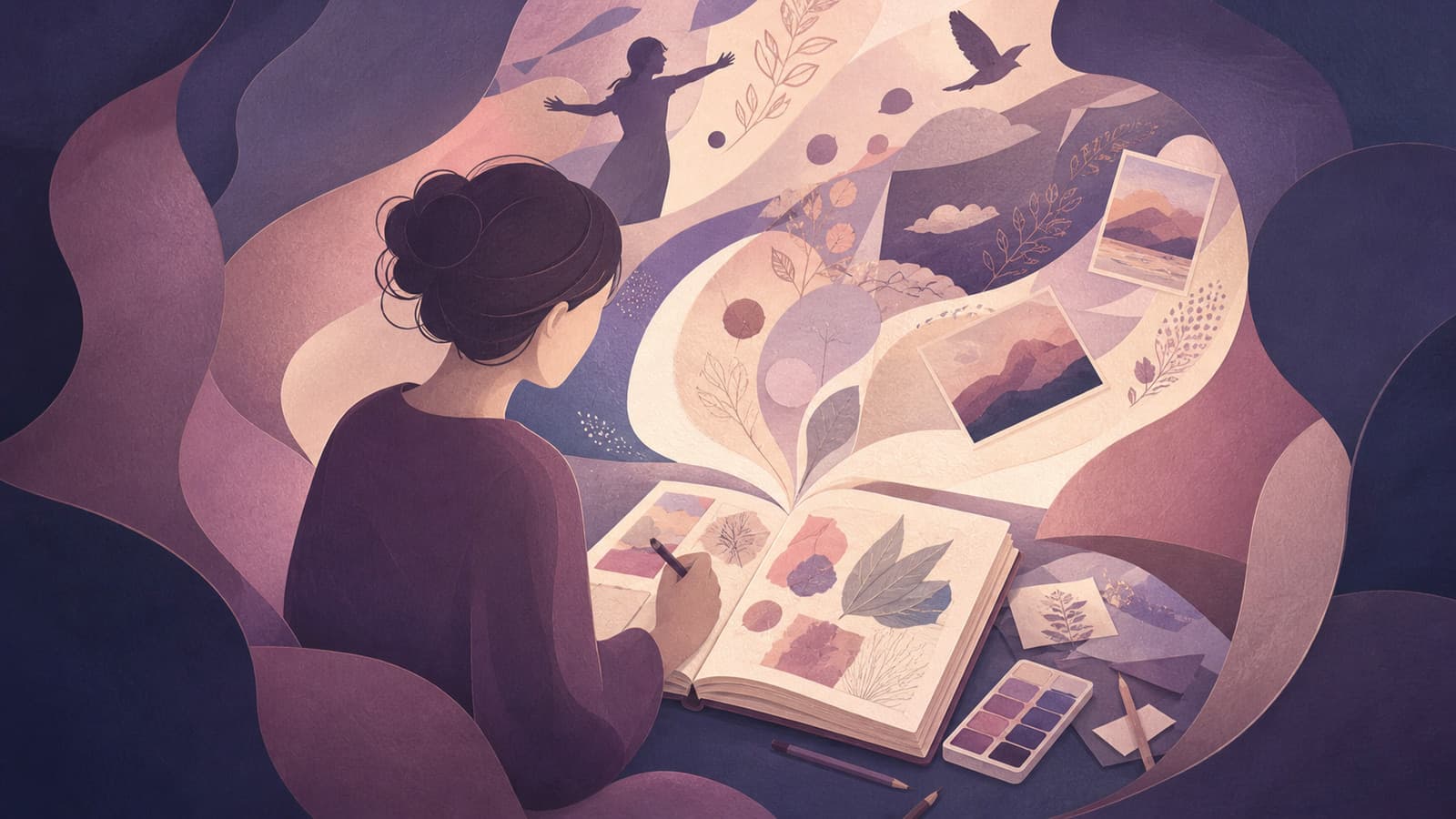
Art journaling is the practice of combining visual elements -- drawings, colours, images, textures, patterns -- with written reflection in a journal format. It sits at the intersection of creative expression and personal introspection.
Unlike a sketchbook, an art journal is not about producing polished artwork. Unlike a traditional written journal, it does not rely solely on words. Instead, it uses the full spectrum of visual language to process experiences, emotions, and ideas.
An art journal entry might be a page splashed with watercolour to represent how you felt during a difficult conversation. It might be a collage of magazine clippings that captures your aspirations for the year. It might be a doodle in the margins next to a paragraph about your day. There are no rules about what it should look like.
The practice has roots in both the fine arts tradition of artist notebooks (think Leonardo da Vinci's journals or Frida Kahlo's illustrated diary) and the therapeutic use of art in psychology. But you do not need to be a da Vinci or a Kahlo to benefit. You just need a willingness to put something -- anything -- on the page.
If you are completely new to journaling in general, our guide to journaling for beginners covers the foundational habits that apply to every journaling style, including art journaling.
Capture Your Creative Moments
Muse Journal lets you combine photos, text, and mood tracking in one beautiful space. Free on iOS.
Why You Do Not Need to Be an Artist
This is the single biggest barrier people face, so let us address it directly.
Art journaling is not about making art. It is about using visual tools for self-expression. The difference matters.
When you make art, there is an audience (even if that audience is you as critic). When you art journal, there is only a process. The page is not a gallery wall. It is a mirror -- sometimes a distorted, messy, imperfect mirror -- and that is exactly the point.
Here is what art journaling actually requires:
- The ability to hold a pen, crayon, or pair of scissors. That is genuinely the only physical skill needed.
- A willingness to make something that looks "bad." Most art journal pages look chaotic, unfinished, or strange. That is normal and healthy.
- Curiosity about what happens when you stop writing and start seeing. Visual expression activates different neural pathways than verbal expression, which is why it can unlock insights that writing alone does not.
Research in art therapy has consistently shown that the therapeutic benefits of visual expression are independent of artistic skill. A 2016 study published in the Journal of the American Art Therapy Association found that just 45 minutes of creative activity significantly reduced cortisol levels in participants -- regardless of their artistic experience or the quality of what they produced.
In other words, the benefit is in the doing, not in the result.
Basic Supplies to Get Started
One advantage of art journaling is its flexibility. You can start with materials you already own, or you can build a dedicated kit over time. Here is a practical breakdown.
The Essentials (Start Here)
- A journal or notebook. Thicker paper handles wet media better, but any notebook works for dry techniques like coloured pencils and collage. A blank or dotted journal gives more freedom than lined pages.
- Pens and pencils. Whatever you write with already. Black fine-tip markers are particularly versatile.
- Coloured pencils, crayons, or markers. Even a basic set of 12 colours opens up significant expressive range.
- A glue stick. For collage work, which is one of the most accessible art journaling techniques.
- Scissors and old magazines. Source material for cutting and pasting images, textures, and typography.
Nice to Have (Add Later)
- Watercolour paints. A small pan set is inexpensive and produces beautiful effects, even for total beginners.
- Washi tape. Decorative tape that adds colour and pattern without requiring any skill.
- Stencils. Useful for creating shapes and patterns when you want structure.
- Stamps and ink pads. Another zero-skill way to add visual interest to pages.
- Acrylic paint and gesso. For those who want to experiment with layering, texture, and mixed media.
The important thing is to start with what you have. You can create a meaningful art journal entry with nothing more than a ballpoint pen and a sheet of printer paper. Do not let the pursuit of perfect supplies delay the pursuit of self-expression.
Simple Techniques for Absolute Beginners
Each of these techniques requires zero prior experience. Try one per journal session and see which resonates with you.
Collage
Collage is arguably the most accessible art journaling technique because it removes the pressure of creating images from scratch. You are curating rather than creating.
How to do it: Flip through old magazines, newspapers, junk mail, or printed photographs. Cut or tear out anything that catches your eye -- images, single words, textures, colours, patterns. Arrange them on your journal page. Glue them down. Write around, between, or on top of them.
Why it works: The act of selecting images bypasses your verbal brain. You often discover themes and connections you did not consciously intend. A page you started with no plan might reveal a clear emotional pattern once you step back and look at it.
Beginner exercise: Set a timer for 15 minutes. Tear or cut out 10-15 images and words from any available source. Without overthinking, arrange them on a page and glue them down. Then write three sentences about what you notice.
Doodling and Mark-Making
Doodling is underrated as a reflective practice. The repetitive, low-stakes nature of doodling allows your mind to wander while your hand stays engaged -- a state that is remarkably productive for processing emotions.
How to do it: Start with a prompt (a feeling, a word, a question) and let your pen move across the page without planning. Circles, spirals, crosshatching, squiggly lines, geometric shapes -- anything goes. Fill margins, corners, or entire pages.
Why it works: Studies on doodling show it improves focus, memory retention, and emotional regulation. When combined with journaling, it creates an entry that captures both the content of your thoughts and their texture.
Beginner exercise: Write a single emotion in the centre of a blank page. Set a timer for five minutes and doodle around it -- shapes, lines, patterns that feel like that emotion. Do not try to draw anything representational. Just make marks.
Colour-Coding and Colour Blocking
Colour carries emotional information. You already know this intuitively -- you describe days as "dark" or "bright," emotions as "blue" or "red." Art journaling makes this metaphor literal.
How to do it: Assign colours to emotions, themes, or categories. Use coloured pencils, markers, paint, or even coloured paper to create blocks, borders, or backgrounds that represent your inner state.
Why it works: Colour bypasses verbal processing entirely. Choosing a colour to represent how you feel is faster and often more honest than finding the right word. Over time, your colour patterns reveal emotional trends you might not notice through text alone. This pairs well with mood tracking -- your colours become a visual record of emotional shifts.
Beginner exercise: At the end of each day this week, choose one colour that represents the day's dominant emotion. Fill a small square on your journal page with that colour. By the end of the week, you will have a simple but powerful visual map of your emotional landscape.
Mixed Media Layering
Mixed media simply means combining different materials on a single page. It sounds advanced, but it is really just the intersection of the techniques above.
How to do it: Start with a background (paint, coloured paper, or even a page from an old book). Add a layer of collage images. Write or draw on top. Add decorative elements like washi tape or stamped patterns. Build the page gradually rather than planning it in advance.
Why it works: Layering mirrors the complexity of real experience. No single day or emotion is one-dimensional, and a layered page reflects that truth. The process of building up and sometimes covering over is itself therapeutic -- it teaches you that you can add to, revise, and transform your story.
Beginner exercise: Start with a page painted or coloured in a single wash. Let it dry. Glue one image on top. Write one sentence. Add one piece of decorative tape. That is a mixed media page. You just did it.
Art Journaling Prompts
If you are used to written journal prompts, visual prompts work on the same principle -- they give you a starting point so you do not face the paralysis of a blank page. Here are prompts designed specifically for art journaling.
Emotion-Based Prompts
- Draw your current mood using only abstract shapes and colours. No words allowed.
- Create a "weather report" for your inner state today. Are you stormy, sunny, foggy, or somewhere between?
- Find and collage three images that represent how you felt this week. Write one sentence under each.
- Use two contrasting colours to represent a conflict you are experiencing. Let them overlap in the middle.
Memory-Based Prompts
- Illustrate a childhood memory using only five colours.
- Collect textures (fabric scraps, leaves, receipts, ticket stubs) from the past week and arrange them on a page with brief annotations.
- Draw the floor plan of a place where you felt safe. Label the rooms with memories.
- Create a visual timeline of your day using simple icons or symbols instead of words.
Future-Oriented Prompts
- Collage a "vision page" for the next three months using magazine images that represent your goals.
- Draw the door you want to walk through next. What does it look like? What is on the other side?
- Create a colour palette for the life you want to live. Name each colour with a quality (courage, calm, abundance).
- Design a simple map of where you are now and where you want to be, with the path between them.
Gratitude and Observation Prompts
- Sketch three small things you noticed today that were beautiful. Skill does not matter -- stick figures and wobbly lines count.
- Create a page using only found text (words cut from newspapers, packaging, or printed materials) to express what you are thankful for.
- Choose one object in your room and draw it three times: once quickly (10 seconds), once slowly (2 minutes), and once with your non-dominant hand.
Digital Art Journaling
Not everyone wants to work with physical materials, and that is perfectly valid. Digital art journaling offers its own advantages -- portability, undo buttons, an infinite supply of materials, and easy integration with your existing journaling practice.
If you are weighing the options, our comparison of digital and paper journaling explores the broader trade-offs. For art journaling specifically, here is what to consider.
Digital Tools and Approaches
- Photo journaling. The simplest form of digital visual journaling. Capture images throughout your day and pair them with written reflections. Our photo journaling guide covers this approach in depth.
- Drawing apps. Tools like Procreate, Adobe Fresco, or even the built-in markup tools on your phone let you sketch, paint, and layer digitally.
- Journaling apps with photo support. Apps like Muse Journal let you embed photographs directly into your entries, creating a hybrid visual-and-written record without needing a separate tool.
- Digital collage. Collect screenshots, saved images, and digital clippings. Arrange them in a note or journal entry with your reflections.
The Hybrid Approach
Many art journalers use both physical and digital methods. You might maintain a physical art journal for deep, tactile creative sessions while using a digital journal app for daily photo-and-text entries. The two practices complement each other -- the physical journal gives you sensory engagement, while the digital journal gives you convenience, searchability, and privacy.
The Therapeutic Benefits of Art Journaling
Art journaling is not art therapy (which requires a trained therapist), but it shares some of the same mechanisms and benefits. Here is what the research and clinical experience consistently show.
Emotional Regulation
Translating emotions into visual form creates distance between you and the feeling. You are not just experiencing anger or sadness -- you are representing it, giving it a shape and a colour. This act of externalisation helps you observe your emotions rather than being consumed by them.
Processing Difficult Experiences
Some experiences resist verbal expression. Trauma, grief, and complex emotional states often live in the body and in images rather than in words. Art journaling offers an alternative pathway for processing these experiences -- one that does not require you to narrate or explain, just to express.
Self-Discovery
Your visual choices reveal things your conscious mind may not recognise. The colours you gravitate toward, the images you select, the shapes you draw -- these all carry meaning. Over weeks and months, patterns emerge that illuminate your values, fears, desires, and growth.
Stress Reduction
The focused, tactile nature of art journaling -- cutting, gluing, painting, drawing -- engages the parasympathetic nervous system. It is a form of active meditation that pulls your attention into the present moment and away from ruminative thinking.
Building Creative Confidence
Art journaling gradually dismantles the belief that creativity is a talent reserved for the gifted few. As you fill pages without judgement, you internalise a different narrative: creativity is a practice, not a gift, and it is available to everyone. This confidence often spills over into other areas of life. If you want to explore how journaling fuels broader creative thinking, our guide on journaling for creativity goes deeper into that connection.
How to Build an Art Journaling Practice
Starting is one thing. Sustaining is another. Here are principles that help art journaling become a regular practice rather than a one-time experiment.
Lower the Bar
Perfectionism kills creative practice faster than anything else. Commit to making ugly pages. Give yourself permission to glue something down and hate it. The page is not precious. The practice is.
Set a Minimal Commitment
Five minutes, one page, one colour. Make the barrier to entry so low that skipping feels harder than doing. You can always do more once you start, but the starting is what matters.
Keep Supplies Accessible
If your art journaling materials are buried in a cupboard, you will not use them. Keep a small kit -- journal, a few pens, scissors, glue -- somewhere visible and easy to reach.
Combine With Existing Habits
Art journaling does not have to be a separate practice. Add a quick sketch to your morning pages. Paste a photo into your evening journal entry. Doodle during a phone call and then annotate the doodles later. Integration is more sustainable than addition.
Do Not Compare
Social media is full of gorgeous art journal spreads made by experienced artists. These are beautiful, and they are irrelevant to your practice. Your journal is a private tool for self-expression, not a public portfolio. Close Instagram and open your journal.
Review and Reflect
Periodically flip through your past pages. Notice recurring colours, images, and themes. The patterns will surprise you, and they offer a kind of self-knowledge that is difficult to access any other way.
Your First Art Journal Entry
You have read enough. It is time to make something.
Here is a simple exercise that takes 15 minutes and requires nothing more than paper, something to write with, and something to add colour (coloured pencils, crayons, markers, or even a highlighter).
- Write one word in the centre of a page. Choose a word that describes how you feel right now.
- Pick a colour that feels like that word. Use it to draw a border, a shape, or a background around the word.
- Add three marks -- lines, dots, squiggles, whatever your hand wants to make.
- Write one sentence somewhere on the page about why you chose that word.
- Step back and look. That is an art journal entry. It is not pretty. It is not supposed to be. It is yours.
Art journaling is not about what you create. It is about what you discover in the process of creating. Every page -- messy, imperfect, unfinished -- is a step toward understanding yourself more fully.
Start today. Your journal is waiting.