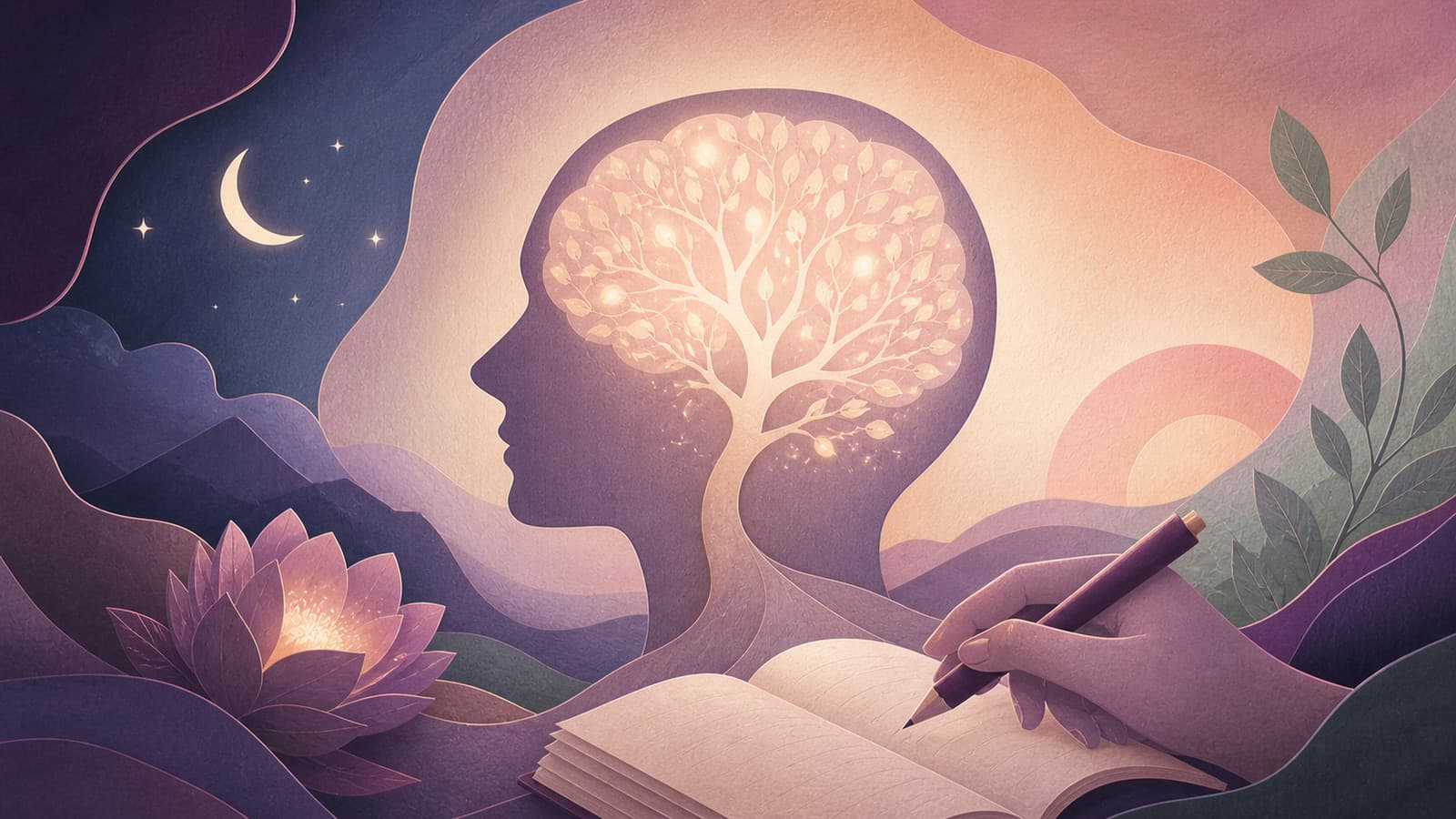
Menopause Is a Transition, Not a Diagnosis
Somewhere in your forties or fifties, your body begins a shift that will touch every part of your life. Your sleep changes. Your moods become less predictable. Your relationship with your own body feels unfamiliar. And the culture around you treats this as a problem to solve, a decline to manage, or -- worse -- something to endure in silence.
Menopause is none of those things. It is a biological transition as natural as puberty, and like puberty, it rewires you physically, emotionally, and psychologically. The difference is that puberty came with a cultural script. People expected you to struggle, and they offered patience. Menopause comes with far less understanding and far more stigma.
Journaling will not stop a hot flash. It will not restore estrogen levels or guarantee eight hours of uninterrupted sleep. But it will give you a structured way to track what your body is doing, process the emotional complexity of this stage, communicate effectively with your doctors, and -- perhaps most importantly -- reclaim the narrative of this transition from a culture that treats it as a loss rather than a passage.
This guide offers specific journaling techniques for the physical, emotional, and identity-level changes that menopause brings. Whether you are in perimenopause, menopause, or postmenopause, these practices will help you move through this transition with clarity and agency. If you have navigated other major life transitions through journaling, many of those same skills apply here -- though the terrain is uniquely your body.
Your Private Menopause Journal
Track symptoms, moods, and hormonal patterns in Muse Journal -- encrypted, searchable, and always with you. Free on iOS.
Building a Symptom Tracking Practice
Menopause produces a staggering range of physical symptoms, and their intensity, frequency, and combination vary enormously from person to person. Hot flashes, night sweats, joint pain, brain fog, heart palpitations, headaches, weight changes, and digestive shifts are just the commonly discussed ones. Many women experience symptoms they never connected to hormonal changes until they started tracking.
Consistent symptom tracking transforms your relationship with these changes. Instead of feeling blindsided by each new development, you begin to see cycles, triggers, and connections that give you a sense of agency.
What to Track Daily
Hot flashes and night sweats. Record the time, duration, and intensity on a 1-10 scale. Note what you were doing when it started. Over weeks, patterns emerge. You may discover that caffeine, alcohol, spicy food, stress, or certain environments reliably trigger episodes. You might notice that hot flashes cluster at predictable times of day. These patterns are invisible without a written record.
Sleep quality and disruptions. How many hours did you sleep? How many times did you wake? Were night sweats involved? Did you feel rested in the morning? Sleep disruption is one of the most impactful menopause symptoms because it amplifies everything else -- mood instability, cognitive fog, pain sensitivity, and fatigue. Our guide on journaling for better sleep offers detailed techniques for building a sleep journal that reveals root causes.
Mood and emotional state. Rate your overall mood on a 1-10 scale and note any significant emotional episodes. Were you unusually irritable, anxious, tearful, or flat? Did anything specific trigger it, or did the feeling arrive without apparent cause? This distinction matters because hormonal mood shifts often feel different from situationally triggered emotions -- they arrive without context and can feel bewildering.
Energy levels. Track your energy at morning, midday, and evening. Note when crashes occur and what you were doing beforehand. Many women in perimenopause experience a new pattern of energy depletion that their old coping strategies cannot address. Seeing the pattern on paper is the first step toward adapting to it rather than fighting it.
Cognitive function. Brain fog is real and frustrating. Note episodes of word-finding difficulty, forgetfulness, or difficulty concentrating. Tracking these helps you distinguish between hormonal cognitive effects and the anxiety that often accompanies them.
The Weekly Pattern Review
Every Sunday, spend fifteen minutes reviewing the past seven days of entries. Look for connections. Did poor sleep nights correlate with higher irritability the next day? Did hot flash intensity drop during a week when you exercised more? Did brain fog episodes cluster around certain times in your cycle if you are still menstruating?
Write a brief summary of what you noticed. These weekly summaries become the basis for your doctor conversations and for the lifestyle adjustments that actually help.
Tracking Hormones and Recognizing Patterns
If you are in perimenopause and still menstruating, your cycles may become unpredictable -- shorter, longer, heavier, lighter, or skipped entirely. Tracking your cycle alongside your symptoms reveals the hormonal architecture beneath the surface chaos.
Record the first and last day of each period, flow intensity, and any notable symptoms during each phase. Over several months, you may discover that your worst symptom clusters correspond to specific hormonal shifts. Brain fog might peak in the luteal phase. Anxiety might spike during the days your period would have arrived in a skipped-cycle month. Hot flashes might intensify in the week before menstruation.
If you are taking hormone replacement therapy, tracking becomes even more valuable. Record when you take your medication, any dosage changes, and how your symptoms respond over the days and weeks that follow. This creates a concrete record of what is working and what is not, which is far more useful to your doctor than a general impression of how you are feeling.
The Body Connection
Menopause does not just affect your hormones. It changes your relationship with your body on a sensory level. Practicing body scan journaling during this period helps you stay connected to physical changes as they happen rather than discovering them in retrospect. Where do you carry tension now that you did not before? Has the quality of your physical comfort shifted? Are there new aches, new sensitivities, or new areas of numbness? Writing about these somatic experiences keeps you attuned to your body rather than alienated from it.
Processing the Emotional Landscape
The emotional experience of menopause is far more complex than the "mood swings" label suggests. Yes, hormonal fluctuations can produce sudden irritability, unexpected tears, or free-floating anxiety. But there are also deeper emotional currents running beneath the hormonal surface -- currents that deserve attention, not dismissal.
Grief and Loss
Menopause marks the end of reproductive capacity. Even for women who never wanted children, or who are finished having them, there is often a quiet grief when that door closes permanently. The grief is not necessarily about babies. It is about the finality. A chapter of your biological life is ending, and that carries weight even when you are ready for it.
If you had children, menopause may coincide with them leaving home. If you did not, this transition may stir up old decisions and the feelings around them. Either way, there is loss to process, and your journal is the safest place to do it without judgment.
Write about what this ending means to you specifically. Not what it is supposed to mean. Not what other people say it should mean. What it actually means, in your own words, for your own life. Give the grief room.
Rage and Frustration
Many women in perimenopause experience a kind of anger they have never felt before -- intense, sudden, and disproportionate to its apparent trigger. Some of this is hormonal. But some of it is decades of accumulated frustration finally finding an exit.
Menopause often arrives when women are exhausted from years of caregiving, accommodating, and putting other people's needs first. The hormonal shift strips away the filter that kept that exhaustion polite. What surfaces is not irrational. It is honest.
Your journal is the place to let that anger speak. Write it raw and uncensored. You do not need to act on it. But you do need to hear what it is telling you. Often, beneath the rage, there are boundaries that need setting, needs that have been neglected, and a self that has been compressed for too long. Techniques from journaling for stress relief can help you channel this intensity productively -- not to suppress it, but to understand what it is asking you to change.
Anxiety and Uncertainty
Hormonal changes can trigger anxiety in women who have never experienced it before. The sudden onset of racing thoughts, physical tension, or a persistent sense of dread can be deeply disorienting when you have no framework for it.
Track your anxiety with the same rigor you apply to physical symptoms. Rate its intensity. Note whether it has identifiable triggers or arrives without context. Record physical symptoms that accompany it -- chest tightness, shallow breathing, restlessness. Over time, you will learn to distinguish between hormonal anxiety and anxiety with an actual source. Our mood tracking guide provides a structured system for exactly this kind of emotional pattern recognition.
Journaling Through Identity Shifts
Menopause is not just a physical event. It is an identity transition. The culture defines women heavily by their reproductive capacity, their youth, and their appearance. When those markers shift, the question "Who am I now?" becomes urgent and real.
This is both a crisis and an opportunity. The crisis is in the loss of an identity that felt stable, even if you never fully chose it. The opportunity is in the freedom to define yourself on your own terms, possibly for the first time.
The "Who Am I Becoming?" Exercise
Set aside thirty minutes with your journal. At the top of the page, write: "Now that I am no longer __________, I am free to __________."
Fill in the first blank with whatever you feel you are leaving behind. It might be "young" or "fertile" or "the person who could push through on no sleep" or "invisible to the medical system." Fill in the second blank with whatever that release makes possible.
Do this multiple times. You are not looking for one answer. You are mapping a landscape of possibility that has opened up precisely because something else has closed.
Reclaiming Your Story
The dominant cultural narrative about menopause is one of decline. You are losing estrogen, losing bone density, losing collagen, losing your waistline. The language is all subtraction.
Your journal is the place to write a different story. Not a falsely positive one -- you do not need to pretend that hot flashes are fun or that brain fog is enlightening. But alongside the losses, there are genuine gains that deserve documentation.
Many women report that postmenopause brings a clarity of purpose, a reduction in people-pleasing, stronger personal boundaries, and freedom from the monthly hormonal cycle that dominated decades of their lives. These are not consolation prizes. They are real psychological shifts, and they deserve as much journal space as the symptoms.
Preparing for Doctor Appointments
Medical appointments during menopause can be frustrating. Time is limited, symptoms are numerous, and many women report feeling dismissed or under-informed. A journal transforms you from a passive patient into an active participant in your care.
The Pre-Appointment Summary
Two days before each appointment, review the past month of entries and write a one-page summary covering:
- Top three symptoms and their trends: improving, stable, or worsening, with specific data from your tracking.
- Medication effects: If you are on HRT or other treatments, summarize how they are affecting your symptoms with dates and details.
- Questions you need answered: Write them in order of priority. If your appointment is short, your most important questions get asked first.
- Patterns you have noticed: Any connections between symptoms, triggers, cycle changes, or medication timing that you want your doctor to evaluate.
Bring this summary to your appointment. Hand it to your provider or read from it. Either way, your experience is communicated with the specificity that leads to better care.
Sleep Journaling During Menopause
Sleep disruption during menopause deserves special attention because it cascades into every other symptom. Poor sleep worsens mood instability, amplifies pain, impairs cognitive function, and reduces your capacity to cope with everything else.
Create a dedicated evening and morning journal practice. Before bed, record your energy level, mood, caffeine and alcohol intake, exercise, room temperature, and worry level on a 1-10 scale. If worries are keeping you awake, do a brain dump -- write every concern onto the page so your mind can release its grip on them.
In the morning, record hours slept, number of awakenings, night sweat episodes, and how rested you feel. Over weeks, this creates a clear picture of what supports your sleep and what undermines it.
Self-Compassion as a Daily Practice
Menopause asks a great deal of you physically, emotionally, and psychologically. The temptation is to push through it the way you have pushed through everything else -- with willpower, efficiency, and a refusal to slow down.
That approach does not work here. The changes are too deep and too sustained. What works instead is self-compassion -- the practice of treating yourself with the same kindness and patience you would offer a close friend going through the same experience.
The Self-Compassion Check-In
At the end of each journal entry, ask yourself three questions:
- What do I need right now that I am not giving myself? This might be rest, permission to cancel plans, a conversation with someone who understands, or simply acknowledgment that today was hard.
- What would I say to a friend experiencing what I experienced today? Write it down. Then read it back to yourself as if someone who loves you is saying it.
- What am I proud of today, even if it was small? Some days, getting through the day is the accomplishment. That counts.
These three questions take two minutes and consistently shift the emotional tone from self-criticism to self-recognition.
Finding Wisdom in the Transition
There is a reason many cultures historically honored menopause as an elevation rather than a diminishment. The "wise woman" archetype exists because something genuinely shifts in how women perceive themselves and the world after this transition.
The hormonal changes of menopause reduce the biological drive toward accommodation that estrogen supports. What often emerges is a clearer sense of personal truth, a lower tolerance for situations that waste your time, and a deeper connection to what actually matters.
Your journal is the place to capture this emerging clarity. Write about what you no longer have patience for and what you want more of. Write about the values that feel sharper now and the relationships that feel more essential. Write about what you want the next chapter to look like -- not despite menopause, but informed by the perspective it has given you.
This is not the end of something. It is the beginning of a version of yourself that is less filtered, less apologetic, and more precisely who you are. Your journal is both the witness and the tool that helps you get there.