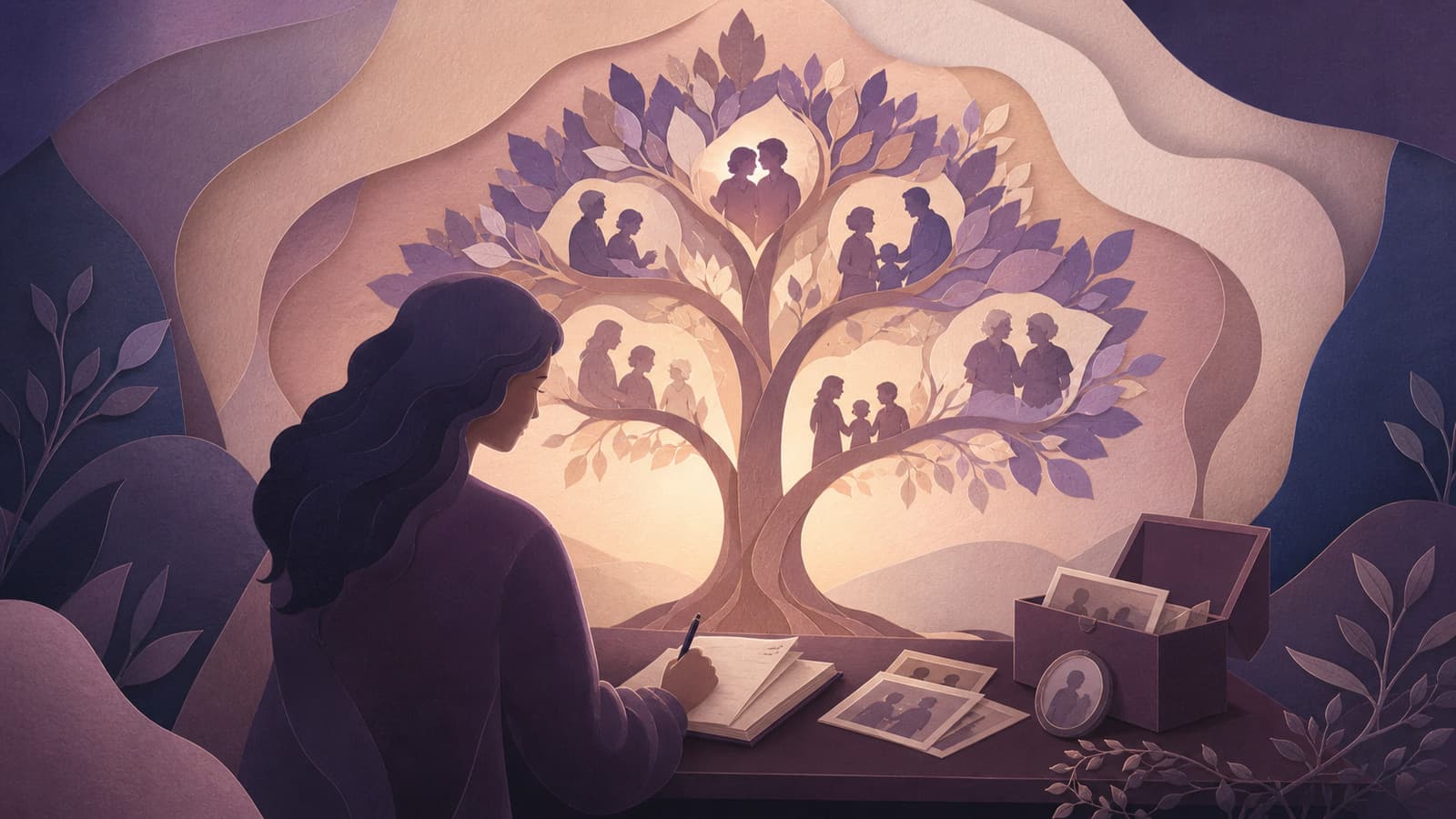
Somewhere in a drawer or a box in the attic, there may be a letter from a grandparent, a faded photograph with a note scrawled on the back, or a recipe card with handwriting you recognize but can no longer hear. These fragments carry weight that no biography or genealogy record can replicate. They are proof that someone lived, noticed things, cared about certain people and places, and took the time to put it down in their own words.
Most of us never receive this kind of inheritance. Not because our parents and grandparents had nothing to say, but because no one asked them, or they assumed their stories were too ordinary to matter. They were wrong. The ordinary is exactly what disappears first and what descendants want most: what daily life felt like, what was valued, what was feared, what was funny around the dinner table.
Legacy journaling is the deliberate practice of writing your life story -- not as a polished memoir, but as an honest, structured record of your experiences, beliefs, lessons, and hopes. It is written with an audience in mind: the people who will come after you, who will one day wonder what kind of person you were and what the world looked like through your eyes.
Why Legacy Journaling Matters
Every family has a point where the story stops. Ask three generations back and most people hit silence. Names on a document, maybe a photograph, but nothing that tells you who that person actually was. What made them laugh. What kept them up at night. What they believed about love, work, courage, or raising children.
This loss is not dramatic. It happens quietly, one generation at a time. The stories your grandmother told at holiday dinners die with the last person who heard them. The details of your father's childhood that he mentioned once in passing are gone the moment no one writes them down.
Legacy journaling interrupts this process. It creates a document that survives the limitations of oral tradition -- the forgetting, the distortion, the simple fact that people die before they finish telling their stories. A written legacy does not depend on someone being in the room to hear it. It waits. It can be read by a great-grandchild not yet born.
The value is not only historical. The act of writing a legacy journal changes the writer, too. It forces you to identify what you actually believe, what your life has actually taught you, and what you most want the people you love to understand. It is a form of reflective journaling with a purpose beyond self-understanding -- it is self-understanding in service of connection across time.
Research on narrative identity shows that the stories we construct about our lives are central to our sense of meaning. People who can articulate a clear life narrative -- one that integrates difficult experiences into a larger arc -- report higher well-being. Writing your legacy is not just a gift to others. It is a way of making sense of your own life while you are still living it.
Start Your Legacy Journal Today
Muse Journal gives you a private, beautiful space to write the stories that matter most. Organized, searchable, and always with you. Free on iOS.
What Makes a Meaningful Legacy Document
A legacy journal is not a resume. It is not a timeline of achievements or a list of dates and locations. The most meaningful legacy documents share three qualities: specificity, honesty, and voice.
Specificity means concrete details. Not "We were poor" but "We shared one pair of good shoes between three kids, and whoever had a job interview that week got to wear them." Not "I loved your grandmother" but "She had this habit of humming while she cooked, and for years after she died I would stand in the kitchen and listen for it."
Honesty means including the complicated parts. Families that only pass down polished success stories leave their descendants with impossible standards. The struggles matter. The mistakes matter. The things you wish you had done differently are often the most useful thing you can share with someone who will face their own versions of those same crossroads.
Voice means writing the way you actually think and speak. Your descendants do not want a textbook. They want you -- your humor, your rhythms, your particular way of seeing the world. If you swear, swear. If you are sarcastic, be sarcastic. Authenticity is the entire point.
Life Story Prompts Organized by Life Stage
One of the biggest barriers to legacy journaling is not knowing where to start. A blank page and the instruction "write your life story" is paralyzing. Structured prompts solve this by breaking the task into manageable, specific questions.
These prompts work well as a sustained practice -- one prompt per session, revisited and expanded over time. If you already use journal prompts that work as part of your regular practice, these can supplement them when you are focused on legacy writing.
Childhood and Family Origins
- What is your earliest memory? Describe the place, the people, and what you felt.
- What did your childhood home look, sound, and smell like?
- What were the unspoken rules in your family? What was considered important, shameful, funny, or off-limits?
- Describe a typical meal in your household. Who cooked? What was served? Where did everyone sit?
- What was your relationship with each parent or primary caregiver like?
Adolescence and Coming of Age
- What was the first significant decision you made for yourself? How did it turn out?
- Describe a moment when your understanding of the world shifted -- when you realized something about life, people, or yourself that you had not understood before.
- Who influenced you most during your teenage years, and what did they teach you?
- What did you dream about becoming? How does that compare to what actually happened?
Adulthood and Relationships
- How did you meet the most important people in your life? What made those connections last?
- What was the hardest year of your adult life, and what got you through it?
- Describe the moment you became a parent, if applicable. What surprised you most about it?
- What is a failure you are grateful for?
Later Life and Perspective
- What do you know now that you wish you had known at twenty?
- What are you most proud of that has nothing to do with professional achievement?
- What do you want your descendants to understand about the era you lived through?
- If you could ensure your family remembered one story about you, which would it be?
Recording Family History and Cultural Heritage
Your individual story exists within a larger context. The traditions, languages, foods, and cultural practices of your family are part of your legacy -- and they are often the first things to disappear when they are not documented.
Legacy journaling provides a natural framework for recording this heritage. You are not writing an academic history. You are capturing what you personally experienced and were told.
Write about the traditions your family practiced and where they came from. Record the recipes that were never written down -- not just the ingredients but the way they were made, the occasions they were associated with, the person who made them best. Document the phrases, sayings, or words from another language that your family used, especially ones that do not translate easily.
If your family has a migration story, write it from the most personal angle possible. Not the geopolitical context, but what your grandparents packed when they left, what they missed most, and what customs they kept alive against the current of assimilation.
This kind of documentation pairs naturally with the practices described in memory keeping through journaling, which focuses on capturing experiences before they fade. For legacy purposes, the urgency is even greater. The people who hold these memories are aging.
If your parents or grandparents are still alive, interview them. Write down what they tell you. Record their voices if they will allow it. Ask them the prompts listed above. In most cases, people are grateful to be asked. They have been waiting for someone to care.
Lessons Learned and Wisdom to Pass On
Every life contains practical wisdom that was earned at a cost. Legacy journaling gives you a way to pass this wisdom forward without requiring your descendants to pay the same price.
Write about the mistakes that taught you the most. Not in vague, motivational terms, but with specificity. What happened, what you thought at the time, what you did, and what you eventually understood. A sanitized lesson about "believing in yourself" teaches nothing. An honest account of a time you made a terrible decision and slowly figured out how to rebuild -- that teaches everything.
Include the practical alongside the philosophical. Write about what you have learned about managing money, navigating conflict, raising children, and handling grief. Write about what you wish someone had told you about marriage, career changes, or the way friendships evolve as you age.
These entries do not need to be comprehensive or systematic. They can be written as they come to you -- a single lesson per entry, accumulated over months and years into a body of hard-won understanding. If you already practice reviewing your journal periodically, those review sessions are excellent opportunities to identify recurring themes and distill them into legacy lessons.
Values and Beliefs Documentation
What you believe -- about right and wrong, about what matters, about how people should treat each other -- is one of the most important things you can leave behind. Not because your descendants will agree with everything, but because understanding your values helps them understand their own.
Write about the principles that have guided your decisions and where those principles came from -- whether from religion, philosophy, experience, or the example of specific people. Write about the times your values were tested, when it was hard to do what you believed was right, and what happened when you fell short.
Be willing to document how your beliefs have changed over time. Few things are more valuable to a young person than the knowledge that the adults they look up to also went through periods of doubt, revision, and growth. Showing that your worldview evolved gives your descendants permission to let theirs evolve too.
Write about what you hope for them. Not instructions -- the world they inhabit will be different enough that specific directives are likely to be irrelevant. But hopes and values you would want to see carried forward. These are the things that transcend generational change.
Letters to Future Descendants
One of the most powerful legacy journaling practices is writing letters directly to people who do not yet exist. A letter to an unborn grandchild. A letter to your family on a future holiday. A letter to whoever finds your journal decades from now.
This practice draws on the same principles that make letter writing in a journal so effective for emotional processing. The direct address -- writing to someone rather than about your life -- produces warmer, more personal, more honest writing. You say things in a letter that you would never include in a formal memoir.
Write a letter for specific occasions: to be read at a graduation, a wedding, the birth of a first child, or during a period of difficulty. These letters become anchors across time, connecting your voice to moments you will not be present for.
For parents who journal, this practice has particular resonance. You are already documenting your children's lives in real time. Legacy letters extend that practice forward, creating messages that your children will not read for years or decades -- messages that gain meaning as they age into the experiences you are writing about.
Practical Tips for Organizing a Legacy Journal
A legacy journal that cannot be found, understood, or navigated by its intended readers fails at its core purpose. Organization matters.
Create sections. Divide your legacy journal into clear categories: childhood, family history, relationships, lessons, values, and letters. This allows readers to find what is relevant to them without reading everything sequentially.
Date every entry. Your descendants will want to know when you wrote something -- how old you were, what was happening in the world, where you were in your life.
Include context for references. Names, places, and events that are obvious to you may be meaningless to a reader in 2075. When you mention a person, briefly note who they are. When you reference a historical event, include enough context that someone unfamiliar with it can understand why it mattered.
Write regularly, not perfectly. A legacy journal is built over time, not in a single weekend. One prompt per week, sustained over a year, produces fifty-two entries -- more than enough for a rich, textured document.
Tell your family it exists. The most meticulously written legacy journal is worthless if no one knows about it. Tell your family what you are creating and where it is stored.
Digital vs. Physical Legacy Preservation
The question of format matters more for legacy journals than for any other type of journaling, because the time horizon is measured in generations, not years.
Physical journals -- handwritten notebooks, printed pages, bound volumes -- have proven durability. Paper survives centuries under reasonable conditions. Handwriting carries emotional weight that typed text does not. The disadvantages are vulnerability to fire, water, and loss, and the fact that a single physical copy can only be in one place.
Digital journals have different strengths. They are easily duplicated, searchable, and can include photographs, audio, and other media. They can be shared instantly with family members across the world. But digital formats face a preservation challenge that paper does not: technological obsolescence. The file format you use today may not be readable in fifty years. The cloud service you rely on may not exist.
The most robust approach combines both. Write digitally for convenience, searchability, and backup. Print or export key entries periodically for physical preservation.
Whichever format you choose, the important thing is that you start. A handwritten letter in a shoebox is infinitely more valuable than an empty cloud folder waiting for the ideal conditions to begin.
Beginning Your Legacy
Legacy journaling is not a project you complete. It is a practice you sustain -- one entry, one prompt, one letter at a time, accumulated over years into something that did not exist before you wrote it. The life you have lived, the things you have learned, the people you have loved -- all of it matters to someone who has not been born yet.
You do not need to be old to start. You do not need to have accomplished something extraordinary. You need only the willingness to sit down and answer, honestly and specifically, the questions that your descendants will wish they could have asked you.
Start with one prompt from the lists above. Write for fifteen minutes. Do not edit. Do not perform. Just tell the truth about one part of your life, in your own voice, and trust that it will matter to someone someday.